Commanding the Storm
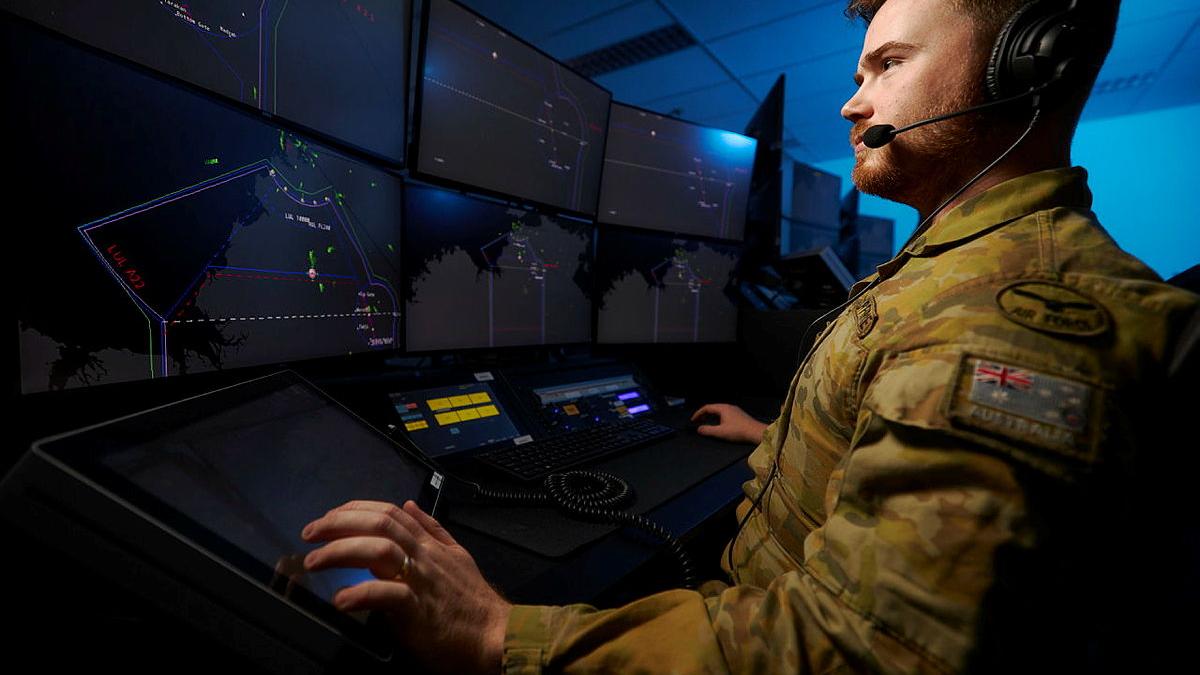
Against the backdrop of complex and dynamic air operations, Exercise Diamond Storm participants relied on tactical command and control (TAC C2) to maintain battlespace awareness, synchronise effects across the integrated force and enable timely decision-making.
As the culminating activity of the Air Warfare Instructor Course, Exercise Diamond Storm highlighted the critical role of TAC C2 and integrated air and missile defence (IAMD), bringing together 2SQN, 3CRU and 114MCRU to deliver a resilient, integrated battlespace management product.
Officer Temporarily Commanding 41WG, WGCDR Andy Boereê, said the exercise demonstrated how TAC C2 enables candidates to synchronise air operations and deliver effects for the integrated force.
“Tactical command and control is the connective tissue of the integrated force. Our ability to collect, interpret and rapidly disseminate information provides operators with the awareness and the decision advantage needed to work effectively in complex environments, and get inside the adversaries’ OODA [observe, orient, decide and act] loop,” WGCDR Boereê said.
Australia is widely recognised as a world leader in TAC C2, which remains a key enabler of the integrated force, whether delivered from the airborne vantage point of an E-7A Wedgetail or through ground-based systems operated by control and reporting centres and agile command and control elements.
'Tactical command and control is the connective tissue of the integrated force.'
Air battle managers, air surveillance operators, Australian Army air defence artillery fire control officers and Royal Australian Navy fighter controllers work together to collect, interpret and disseminate critical battlespace information, providing commanders with the awareness and decision advantage required to operate inside an adversary's decision cycle.
“The integration of airborne and ground-based command and control capabilities enables Australian and coalition forces to share information, synchronise operations and generate the decision advantage required for effective integrated air and missile defence,” WGCDR Boereê said.
Providing the airborne component, 2SQN’s E-7A Wedgetail delivered deep battlespace awareness, early warning and dynamic battle management. Its ability to be rapidly re-tasked in flight enabled responsive control of offensive and defensive counter-air operations, making it a significant force multiplier. Integrated with 41WG’s ground-based command-and-control network, the Wedgetail ensured a persistent and shared understanding of the battlespace.

Meanwhile, 3CRU and 114MCRU provided the backbone of the persistent ground-based IAMD network. From Williamtown, 3CRU executed opposing force command and control while maintaining continuous surveillance and fusing multiple sensor inputs into a combined air picture. Simultaneously, 114MCRU delivered Blue Force command and control from Darwin, with its deployed element at Delamere Air Weapons Range and other agile sites extending radar and communications coverage into the forward battlespace.
As a key contributor to Australia’s IAMD mission, 41WG continues to develop tactics, techniques and procedures that support the development of Australian IAMD doctrine and meet one of the key objectives of the National Defence Strategy, namely the defence of Australia.
Exercise Diamond Storm reinforced that success in high-end operations depends on an integrated TAC C2 network that delivers decision superiority, enhances interoperability and enables the integrated force to stay ahead of potential adversaries. IAMD is not delivered by a single platform, but by a networked system of systems working as one, led by the outstanding aviators of 41WG.
Related stories


