Engineering Navy for the future
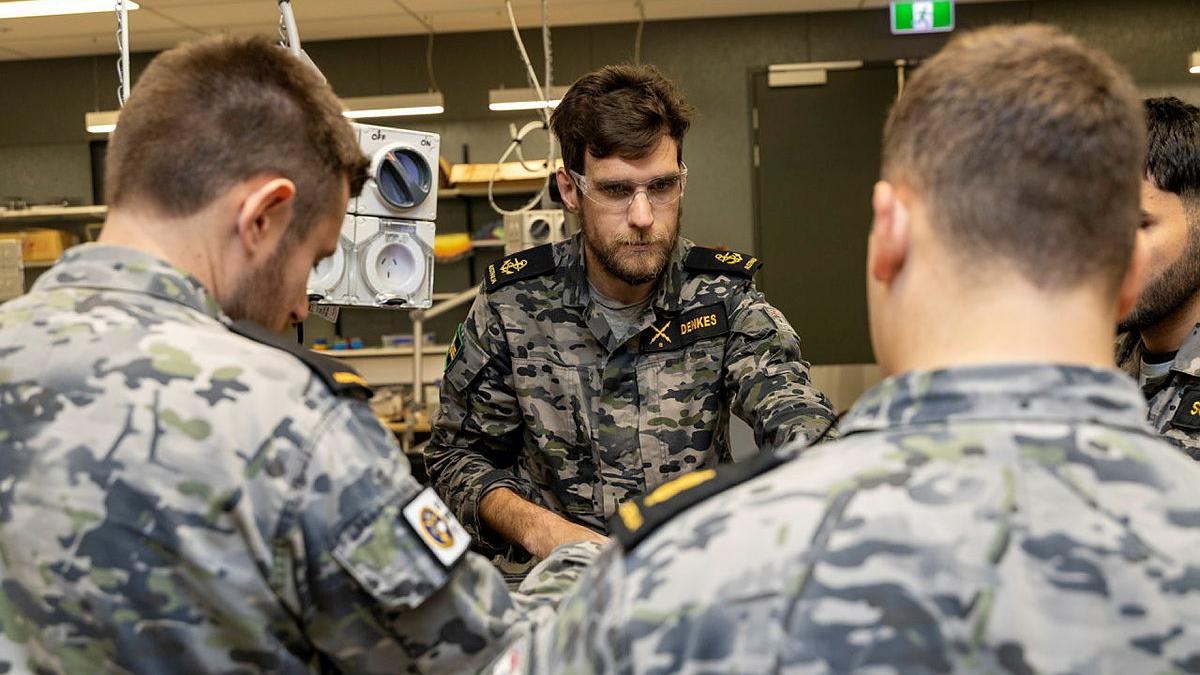
Robotics and 3D printing were among the new technologies being adapted to solve a realistic Navy engineering problem under a program designed to reinvigorate the Navy Engineering Challenge (NEC).
Navy collaborated with Deakin University at its Waurn Ponds campus to run the challenge, which combined technical personnel in a team-based practical activity, from June 1 to 5.
The NEC was designed to strengthen engineering capability, foster innovation and expose personnel to contemporary engineering practices while building partnerships with Australian tertiary institutions.
The pilot involved two teams from HMAS Cerberus, Fleet Support Units South-East and West, and Navy Engineering.
The challenge demanded the integration of mechanical design, control systems and remote operations, and included a hands-on workshop activity, targeted micro-learning and exposure to Deakin’s capabilities and research.
Teams were tasked with designing and developing a mounted mobile system capable of extracting an explosive device from a ship’s bulkhead and remotely operating a valve within a confined compartment.
Former Army Brigadier, now Deakin University Chair in Defence Innovation, Professor Bill Sowry, said the program allowed for deep collaboration.
“Deakin has carried out many Defence projects but, in this context, we don’t necessarily have the insights into what does and doesn’t work and what the user needs,” Professor Sowry said.
“The Navy technicians working with us bring a far better understanding of what needs to be done, and how it can be done, in a way that is implementable on a ship.”

The pilot program deliberately incorporated an inaugural cross-disciplinary team model to reflect Navy’s contemporary operational engineering environments and strengthen integrated problem-solving capability.
This involved incorporating multiple sub-specialisations of marine and electronics technicians in collaborative team environments, allowing participants to integrate their diverse technical knowledge to solve complex problems.
NEC Manager CAPT Andrew Downie said the cross-disciplinary approach was a key principle of the pilot program.
“We had combined teams of marine and electrical technicians drawing on all of their skills, while simultaneously introducing them to new ones,” CAPT Downie said.
“The teams demonstrated an impressive ability to rapidly absorb new information and apply it directly to the challenge, translating learning into functional and innovative solutions within a tight timeframe.
“The pilot foregrounds a full implementation of the challenge later in 2026, where we hope to field four teams of five technicians, competing across a five-day program at the Deakin Waurn Ponds campus.
“We hope to involve our aircraft technicians in the fleet-wide challenge as well.”
The micro-learning component proved effective in stimulating innovation and enhancing participant capability.
Targeted sessions were delivered across computer-aided design, 3D printing, artificial intelligence and control systems engineering, including practical exposure to programmable logic controllers.
The NEC continues to introduce participants to new and innovative technology, providing a platform to trial new ideas, strengthen connections with academia and embed modern engineering practices across the workforce.
The full roll-out of the NEC is scheduled for November 23 to 27 at Deakin University.
Related stories
