Allies work as one in Hawaiian waters
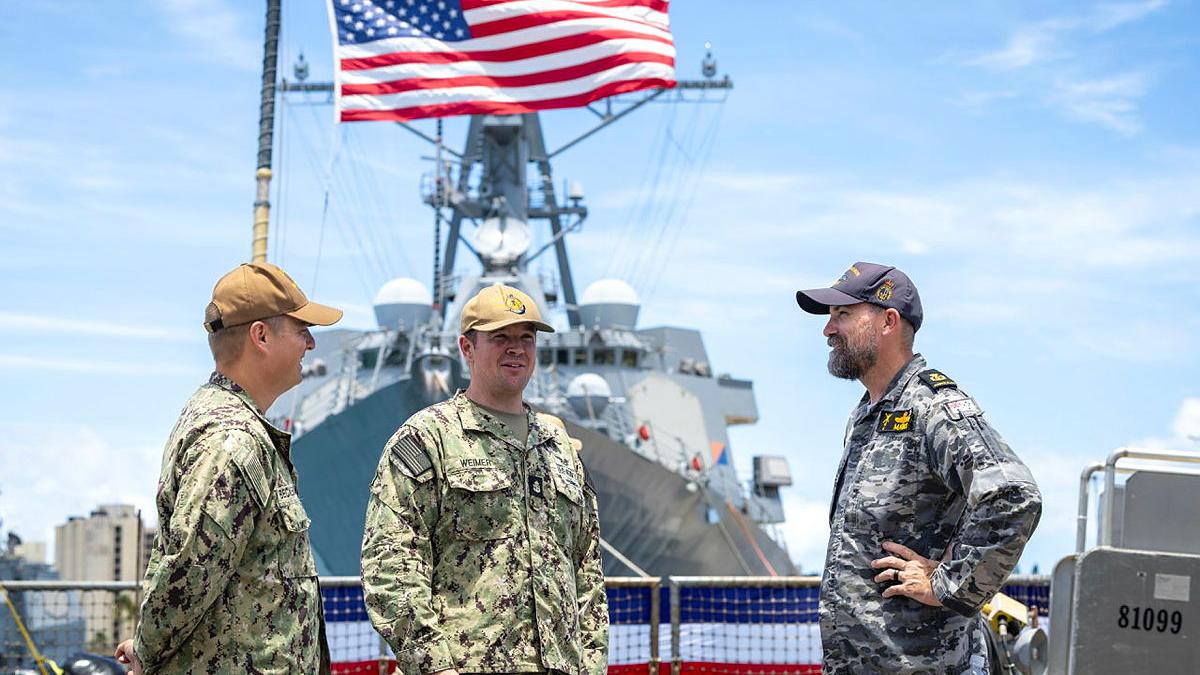
A RAN aviation detachment embarked on board USS Wayne E. Meyer put months of preparation into action during Exercise Rim of the Pacific (RIMPAC).
LCDR Jarrod Huisman, Flight Commander of RAN’s Flight 605, led the Australian detachment during its four-month deployment to Oahu, Hawaii.
Flight 605 integrated with Wayne E. Meyer’s crew to learn how to safely and effectively operate on board the destroyer as part of an interchangeability program.
The detachment comprised 21 personnel, including a communication and information systems sailor and a maritime logistics supply chain sailor.
Throughout the deployment, the team completed extensive integration training, allowing Australian personnel to become fully embedded within the ship's company and conduct aviation operations.
"The Australians have really appreciated being welcomed as part of the ship's company," LCDR Huisman said.
"The integration has allowed us to build strong working relationships while developing a thorough understanding of how the US Navy operates its helicopters at sea."
During RIMPAC, the detachment applied its training across a range of complex maritime operations, including anti-submarine warfare exercises with partner nations.
The team also conducted a live AGM-114N Hellfire missile engagement against a target hulk, alongside HMAS Sydney, demonstrating the combined capabilities of Australian and US naval aviation.
CMDR Ruben Tapia, US Helicopter Maritime Strike Wing Pacific Liaison Naval Officer, was assigned to the Australian detachment as its observer assessor.
CMDR Tapia's primary responsibility was ensuring the safe and effective cooperation between the members of the Australian MH-60R Flight and Wayne E. Meyer’s crew.
Acting as the key liaison between the ship and the detachment, he focused on resolving procedural differences while providing ongoing safety oversight throughout the preparations for RIMPAC.
"Operationally, there have been very minimal challenges," CMDR Tapia said.
"There were slight differences in procedures, but they were identified, mitigated and learned from, on day one. It really was just tiny things that are different and weren't difficult to overcome."
After flying with the Australian detachment, CMDR Tapia praised the professionalism displayed by the crew.
"I flew with the detachment, and we conducted the standard aviation brief completed before every flight," he said.
"Within that brief, I had no qualms, no issues. We took off, executed a full flight, navigation, swapping controls and everything you'd expect.
“I observed how professionally everything was conducted, and the procedures and safety standards are entirely comparable."
CMDR Tapia believes the success of the integration sets a strong foundation for future collaboration between the partner nations.
"I anticipate that future iterations of this program will just go from strength to strength based on everything I've observed from this first experience," he said.

Related stories


