Secrets in shallow waters
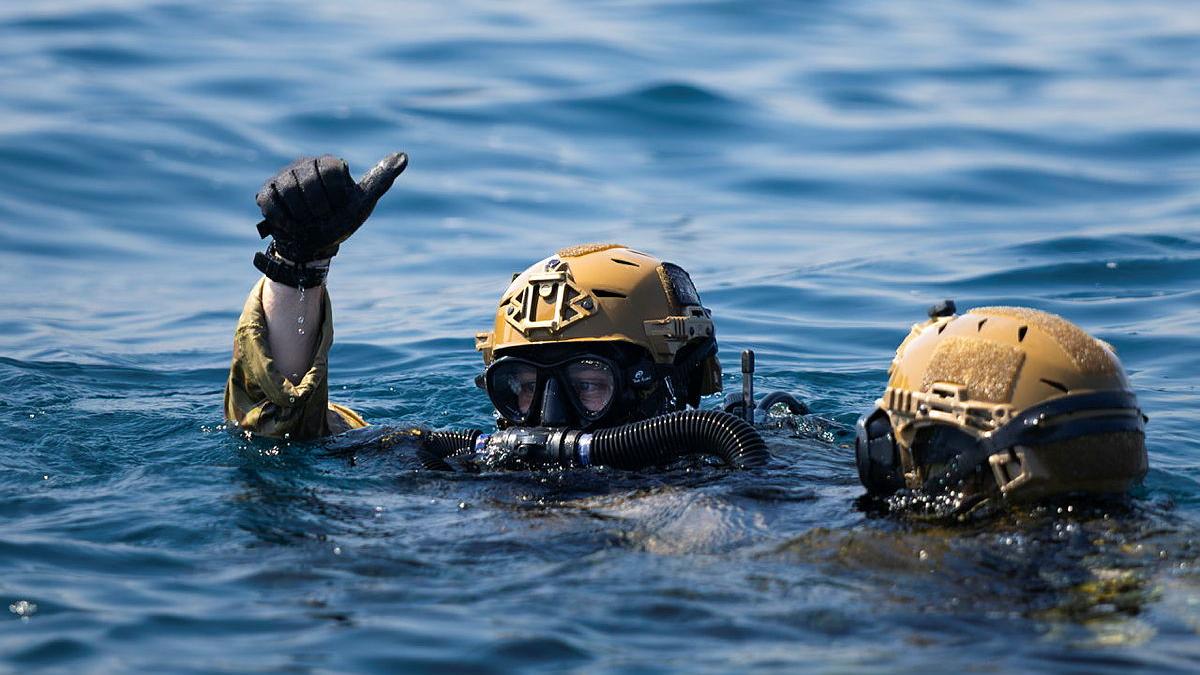
The dangers of being a Navy clearance diver quickly become apparent after learning the nine-member team at Exercise Keris Woomera had their own specialist medic.
The combat operations they perform during an amphibious assault are clandestine, or done in secret, so the risks are high.
If they are spotted doing reconnaissance in shallow waters, they could get shot.
Mines are also a big risk, as well as their specialist equipment.
Mine warfare and clearance diving officer LEUT Brent Solomon said the team medic was a specialist in underwater medicine, including decompression illness specific to diving.
“It can be dangerous,” LEUT Solomon said.
“We are breathing off closed-circuit rebreathers that allow us to dive covertly and for longer mission times without showing any surface bubbles.”

It’s a case of trusting your teammates with your life.
“We operate in pairs and check each other’s dive sets,” LEUT Solomon said.
“Obviously those safety checks have to be thorough to reduce the risk of diving illness. You have to trust your teammates, as the consequences of not being able to can be dire.”
Australian Clearance Diving Team One, based at HMAS Waterhen in Sydney, was part of the Australian Amphibious Force embarked in HMAS Choules for Exercise Keris Woomera in East Java, involving thousands of Australian and Indonesian military personnel.
The ADF’s elite tactical frogmen were eager to do amphibious warfare training alongside the Indonesian Navy’s underwater demolition commando unit, Kopaska.
“It’s a great opportunity to operate with our regional partners,” LEUT Solomon said.
“It shows we can operate as a combined force, that we are ready to respond.”

RAN clearance divers have served in every major conflict since 1951 when the branch was established, including Malaya, Vietnam, the Gulf War, Somalia, East Timor, Iraq and Afghanistan.
Becoming a clearance diver is a gruelling and competitive process with rigorous strength and endurance tests.
As well as mine warfare and reconnaissance, divers are trained in close-quarters combat and search-and-seizure operations, as well as fieldcraft and survival training.
“We’ve all gone through a lot to get here and are highly motivated,” LEUT Solomon said.
It is the hands-on nature of the job that attracted the former maritime warfare officer.
“I was posted to a mine hunting vessel during Operation Render Safe in the Solomon Islands, and as a maritime warfare officer my role was transiting to the location,” LEUT Solomon said.
“The clearance divers were the ones disembarking and going ashore.
“They’d visit the local communities and the school kids would take them by the hand and show them where the caches of World War II unexploded ordnance were, which the divers would clear.
“Seeing those tactical operations was eye opening. I knew immediately that was where I wanted to be.”

See more images of clearance diving operations during Exercise Keris Woomera.
Related stories


