Cutting through history
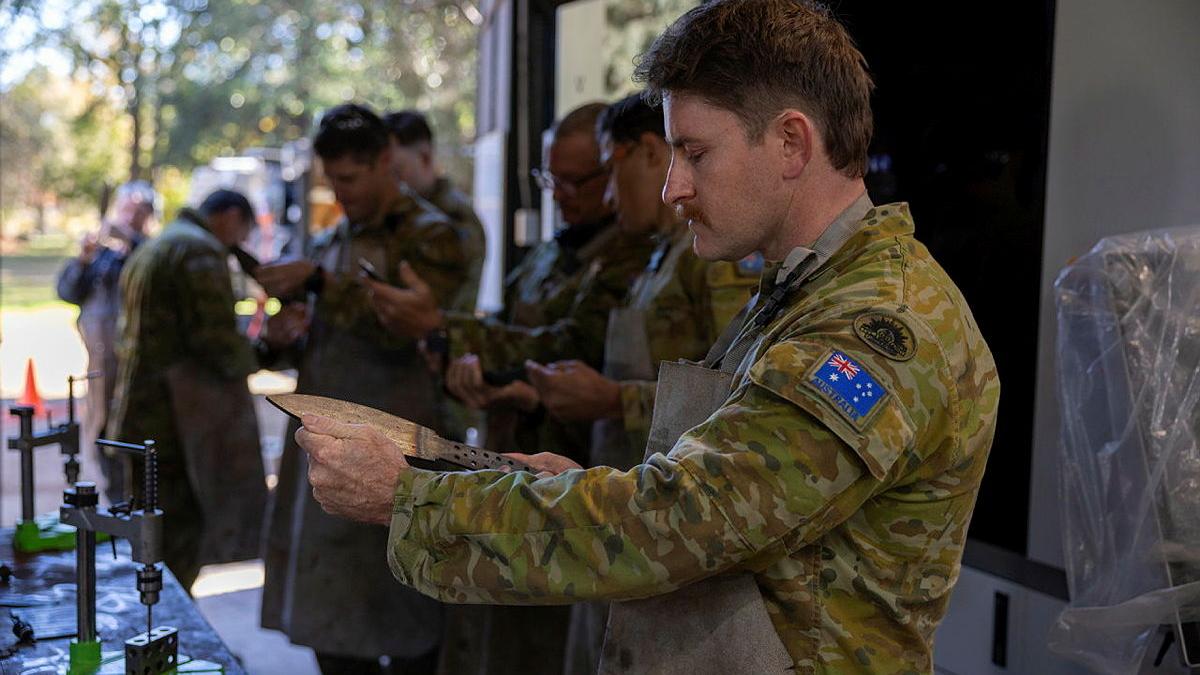
A forge roared and sparks flew as Army soldiers recreated a slice of WWII history at the Tharwa Valley Forge.
With uniforms protected by leather blacksmiths’ aprons, soldiers ground, sanded, drilled and heat-treated steel blanks into a new generation of Australian Coastwatcher knives.
The knives were a culmination of 12 months’ work under the initiative Project Coastwatcher and supported through consultation with the families of WWII Coastwatchers.
Coastwatchers were an intelligence network throughout the Pacific and northern Australia, largely drawn from Australian expatriates and Indigenous Pacific Islander peoples.
Raised in haste, the wartime Coastwatcher network didn’t have a hat badge, colour patch or other symbology. Post-war reunions used bush knives and palm trees instead.
Wartime coastwatchers and scouts often made their own knives by reshaping the large-issued machete, which was considered ill-suited to the jungles of the Indo-Pacific.
These Coastwatcher knives were originally made in 1942 by Solomon Islands soldiers, recruited to serve in northern Australia and assist with raising coastwatching patrols there.
The original Solomon Islander smiths incorporated the Aboriginal Australian shovel-nosed shape (learned in turn from Macassan traders), as well as knife-fighting techniques from 7 Infantry Training Centre and the experience of Indigenous Pacific Islander Coastwatchers.
The result was a distinctly Australian knife with Indo-Pacific heritage.
'The Coastwatcher knife – an Australian knife with Pacific heritage – is used to symbolise the service of the original Coastwatchers as well as the importance of Indigenous knowledge to their success.'

Sgt Joseph Scully, an instructor on the Pilot Coastwatcher Course in 2025, took prototype knives to Arnhem Land to put them through their paces in general bushcraft and field butchery.
“I was quite impressed. The shovel-nose spear design gives a fair amount of belly to the blade, which allows for skinning and slicing, and it’s relatively pointy so you could use it for stabbing whenever you needed to,” Sgt Scully said.
“It’s on the heavier side because it needs to be a bit thicker to be used as a spear, but it was still quite nimble. It also kept an edge quite nicely, especially up against thick buffalo hide and bone.”
The knife also features a full tang for strength and a 90-degree spine for scraping fire steels and batoning.
The handle scales and guard can also be removed for the knife to be used as a spearhead.
Despite drawing from many knife-making traditions, it is a uniquely Australian blade representative of conditions the original Coastwatchers worked in.
Project lead Maj Michael Jones said the first modern knives will be used as gifts during international engagements, but will eventually be available to soldiers who have completed the Littoral Pathfinder training.
“Project Coastwatcher drew upon the heritage of the Second World War Coastwatchers, who are proudly remembered across the Pacific, and engaged closely with the families of Indigenous Pacific Islander Coastwatcher veterans,” Maj Jones said.
“The Coastwatcher knife – an Australian knife with Pacific heritage – is used to symbolise the service of the original Coastwatchers as well as the importance of Indigenous knowledge to their success.”

Related stories


