Soldiers help restore wartime landmark
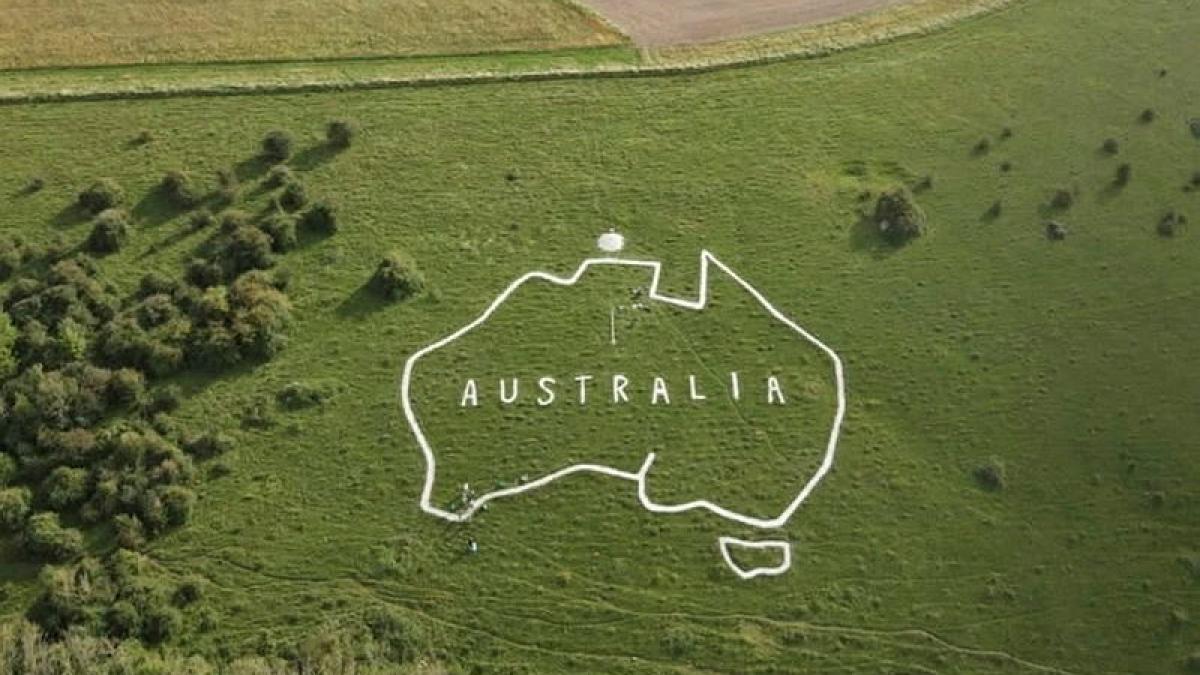
About a dozen Australian soldiers have helped restore a historic chalk hillside carving of a map of Australia in Wiltshire, south-west of London.
The soldiers, training Ukrainian recruits as part of Operation Kudu, worked alongside local volunteers near the small village of Compton Chamberlayne to carefully rehabilitate the chalk map.
Australia’s new Liaison Officer to British Army Headquarters, Lt-Col Fabian Harrison, says the map was originally carved into the hillside by soldiers from the Australian Imperial Force in 1917.
“It’s a special privilege to help upkeep a physical legacy left by the Anzacs,” he said.
There are at least two more hillside carvings made by Australian soldiers during World War I – both of them Rising Sun badges. One is at nearby Fovant Badges and the other is located at Codford, about 20km further north.

Lt-Col Harrison said the Rising Sun carvings are looked after by a charity. The map of Australia is cared for by local residents, who have now set up a trust.
“The soldiers originally dug a narrow trench in the grassy topsoil and then back-filled it in with local chalk stone to make a white line that can be seen from a distance,” he said.
“In the years since the war, the map was left to go into disrepair and became overgrown with grass and weeds. But in 2016, an amazing group of locals put a lot of effort into reinvigorating and restoring the carving to its former glory.”
The map is now visible from the road as drivers pass by, and from the air – becoming an iconic feature of the local landscape.
Helen Roberts, from the Map of Australia Trust, set up in 2017 to look after the site, told the BBC: “The presence of the Australians is felt particularly in the village of Compton Chamberlayne.”
“Lots of soldiers, discharged from hospital, would come to places like Hurdcott Camp and would try and recover, sadly to go [straight] back out to battle.
“Lots of new recruits would come to camp straight from trains in Plymouth.”

Australia’s Head of Defence Staff in London, Air-Cdre Matt Harper, said the commitment and ongoing maintenance of the map are indicative of the deep connections between Australia and the United Kingdom.
“Our shared history is reflected not only in our military cooperation, but in our connection to communities and traditions like this,” Air-Cdre Harper said.
“It means a great deal to us that locals feel so strongly about preserving their heritage, and we are proud that Australian soldiers could play a role in supporting that.”
The restoration was completed in time for Anzac Day, when Australian soldiers stood side-by-side with local volunteers to honour all those who have served and died for the freedoms we enjoy today.
“There were about 50 local residents at the Anzac Day service held at the badge this year – and it’s a very steep climb. Testament to our ongoing connection through shared history, all these years later,” Lt-Col Harrison said.
Related stories


