The danger that lurks beneath
Every year, Army technicians search for and render safe tonnes of dangerous munitions in the Pacific. Words by Capt Annie Richardson, photos by Sgt Andrew Sleeman
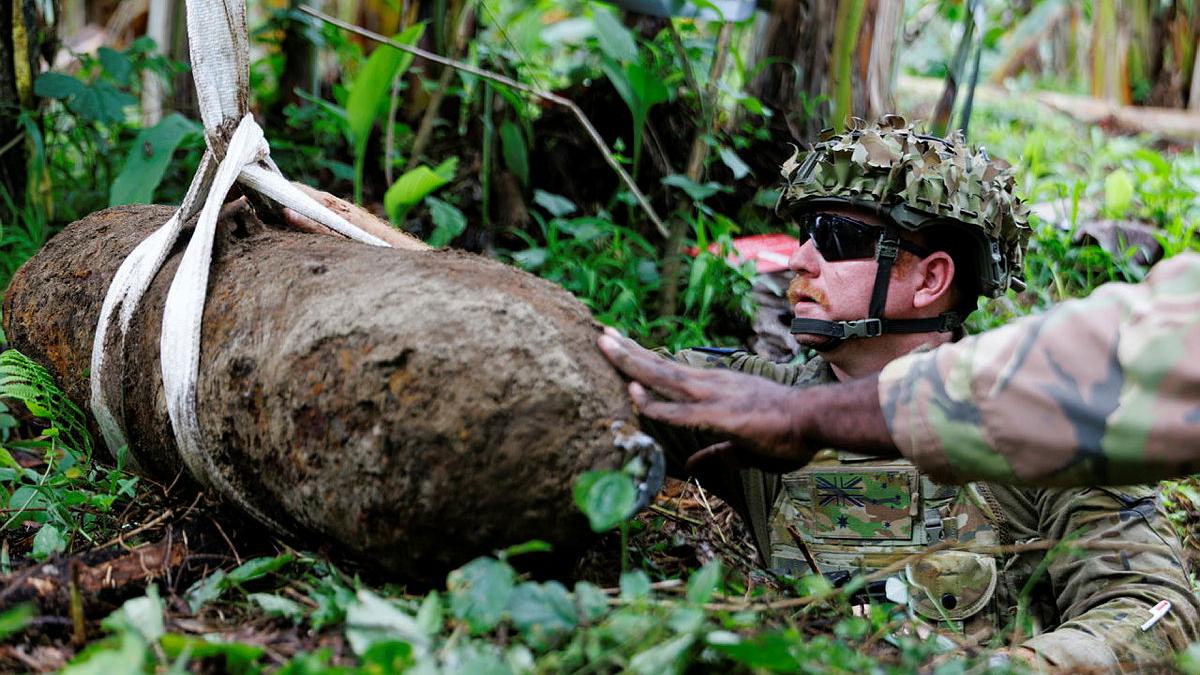
Explosive remnants of war (ERW) can sit undisturbed for decades in waterways and forgotten tracks before being uncovered by shifting soil, weather or farming.
If exposed they retain the same capacity to kill or maim as the day they were left behind.
For decades, Australian Army engineers have been returning to former theatres of war to remove explosive remnants in the aftermath of armed conflict.
Many of these explosive remnants are in areas that were subjected to sustained enemy bombardment where Australian forces were operating.
Dating back to World War II, the work of Australian Explosive Ordnance Disposal (EOD) technicians has spanned campaigns and conflicts across the globe.
Their work has included post-war clearance operations in Papua New Guinea (Bougainville and East New Britain) following the Pacific campaign, the demilitarised zone in the Korean Peninsula, and more recently – on Operation Render Safe – in Vanuatu, Nauru and the Solomon Islands.
More than eight decades after the Pacific campaign, that work continues in the former battlefields of Papua New Guinea.
From May to June this year, EOD technicians and combat engineers of 6ESR and 20 EOD Sqn worked with counterparts and medical, logistics and communications specialists from partner nations to locate and dispose of explosive remnants of World War II in East New Britain on Operation Render Safe.
Now in its 22nd year, the operation is the ADF’s mission to locate and dispose of ERW in the south-west Pacific region.

Over two-year cycles, 20 EOD Sqn conducts technical reconnaissance and identification of explosive hazards in the first phase, before returning for clearance and disposal operations in the second.
The ordnance, hidden under decades of vegetation and volcanic soil, sometimes emerges intact, however, some items are heavily corroded and unstable, their original markings long since worn away by time and climate.
The work by the EOD teams is deliberate and controlled, governed by safety and procedure. From detection to disposal, it is technical and often repetitive work.
After EOD technicians uncover and identify corroded munitions, they must assess if safe to move for final disposal. Some UXO is rendered safe before removal for destruction or, if unsafe to move, blown in place. Depending on the condition of the munitions, items may be transported to a safe disposal area.
It is a job with no room for mistakes, but the risks posed by ERW are not limited to the EOD teams.
In some communities, unexploded ordnance has become so familiar that it risks being mistaken for harmless scrap.
Personnel involved in the many iterations of Operation Render Safe recount incidents of children carrying corroded munitions home after finding them while playing.
In other cases, communities have attempted to use old ordnance as ‘fish bombs’ made by scraping explosive material out of old ordnance and packing it into water bottles before dropping into the ocean, damaging the environment and indiscriminately destroying marine life.

In some Pacific Island nations, there are reports of ERW being used in tribal conflicts to deadly effect, often impacting innocent people.
For families who have lived in former areas of conflict for generations, these remnants continue to injure people and restrict the safe use of land well after the conflict ended, limiting the communities’ farming, development, or the safe expansion of villages.
It’s the persistence of these risks that continues to drive Operation Render Safe more than 20 years after it formally began, and the impact is cumulative. Each munition rendered safe reduces a hazard, and each field clearance returns a parcel of land to safe and ordinary use.
This work is gradual, often invisible, and unlikely ever to end.
There may never be a defined endpoint to Operation Render Safe, nor certainty that every explosive remnant is found, but as long as they remain, so does the ADF’s commitment to remove them.
Related stories


