Medical facility proves its worth
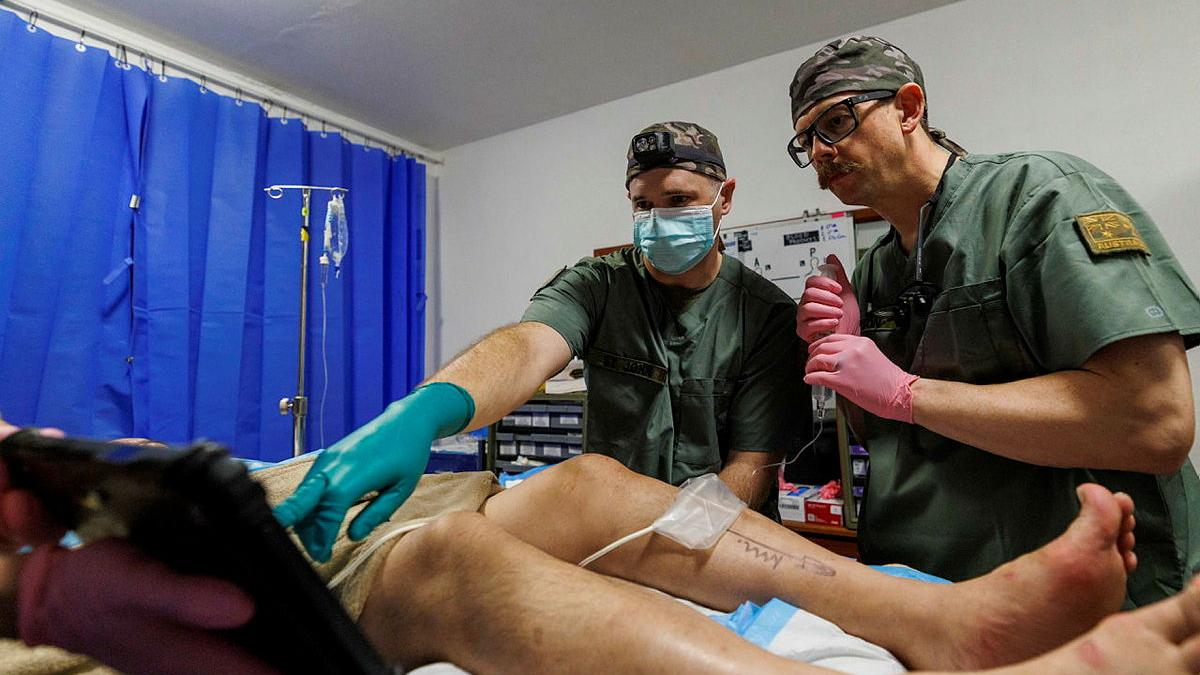
Just two days after unpacking their equipment in PNG, the Role 2 health capability supporting Operation Render Safe had already received its first surgical patients.
Behind the doors of converted hotel rooms in East New Britain, the hum of medical equipment competed with the drone of an overworked air conditioner, as personnel from 3 Health Bn performed surgical procedures on two deployed members with marine foreign body injuries.
For Maj Ashley St John, an anaesthetist from 3 Health Bn, the surgery was an early demonstration of how rapidly deployable health capabilities support operations in austere environments.
“This Role 2 health capability sits between a very small forward surgical capability and its traditional form, being the Role 2 Basic that is almost twice the size,” Maj St John said.
“It gives us a deployable medical facility with an operating theatre, and the ability to stabilise and hold patients before evacuation.”
While the capability is designed to respond to serious trauma associated with explosive ordnance disposal operations, it also supports the treatment of everyday injuries and medical issues.
“We can provide force preservation healthcare. Things like foreign body removals, infections and other injuries that happen during a deployment,” he said.
During one of the procedures, Maj St John provided regional anaesthesia, known as a ‘nerve block’, numbing the patient’s extremity, after which surgeons removed the foreign bodies.
The surgeries were conducted inside a hotel room which, days earlier, contained little more than beds and bedside tables before being transformed into a functioning surgical environment using equipment transported from Australia.
“It’s the first time we’ve operated this capability in hard-standing accommodation like this,” Maj St John said.
“We took the standard Role 2 Basic set-up, reduced it to suit the likely injury profile and mapped the layout before deployment. That preparation allowed us to set up very quickly once we arrived.”

Despite the unconventional layout, the team set up and developed a full set of standard operating procedures specific to the operation within days.
These included how to manage cold chain (maintaining the temperature-controlled supply of medical products) during blackouts, mass-casualty planning, and the activation of the emergency donor panel.
“The challenge is that we’re working across multiple hotel rooms instead of a purpose-built field set-up, so things are more spread out across many rooms, yet also very confined within that space,” Maj St John said.
“It’s definitely a compact and more austere environment.”
Throughout the deployment, the teamwork across Defence health capabilities was evident.
“We all know each other through previous exercises and civilian employment, which is really important because we work closely together in a confined environment,” Maj St John said.
“You need to understand how each person works – when someone needs support and when people need rest.
“Good teamwork is critical.”
Outside his reserve service, Maj St John works full-time as a consultant anaesthetist at Monash Health in Melbourne, but said deployments such as Operation Render Safe offered something unique.
“Army is something I really enjoy. It fills my cup,” he said.
“It’s a different environment, different challenges and a chance to work with people who all share the same mindset.”
Operation Render Safe comprised personnel from the ADF, PNG, France, Canada, Japan, New Zealand, the United Kingdom and the US to dispose of explosive remnants of war in the Gazelle, Kokopo and Rabaul Districts of East New Britain.
Related stories


