Remembering the past with the Fighting First
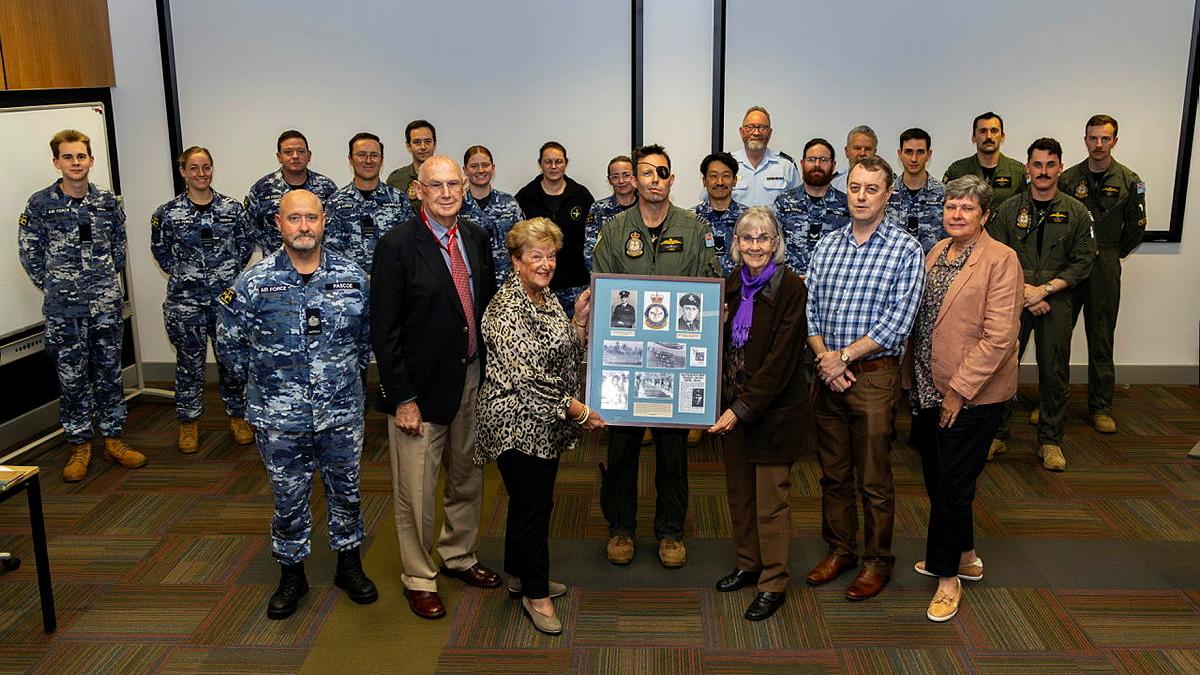
On August 20, aviators from 1SQN took the time to pause and reflect on those who came before them.
Supported by History and Heritage – Air Force’s (HH-AF) Living History Program, 1SQN welcomed the families of two legendary World War II aviators to a presentation connecting the past to the present.
FLTLT Oscar ‘Ossie’ Diamond and WOFF Archie Caswell were both members of 1SQN, operating the Lockheed Hudson bomber, when they found themselves thrown into the desperate fight to stem the Japanese advance down the Malayan Peninsula during WWII.
1SQN played a critical role in defending against the Japanese invasion of Malaya during the last days of 1941 and undertook a fighting withdrawal through Malaya, Singapore, Sumatra and Java.
It was an action that helped define the unit’s moniker: the Fighting First.
WGCDR Richard MacNeil, Head of HH-AF’s Living History Program, spoke of the heroic exploits of 1SQN aviators during this time.
“They never gave up. They kept fighting until they were ordered to surrender. They symbolised the values we live by today, particularly service, courage and excellence,” he said.
At the time, FLTLT Diamond found himself captaining a Hudson tasked with repelling the Japanese invasion force. Despite overwhelming odds and the loss of aircraft and aircrews, the Hudson crews continued to bring the fight to the invading forces.
“Undaunted by losses, 1SQN continued to launch aircraft in a desperate bid to degrade the Japanese landing force and reduce pressure on the defending Allied troops,” WGCDR MacNeil said.
WOFF Caswell, at the time holding the rank of Aircraftman Class 1, served as a radio and radar mechanic on the ground, and his work during the invasion had an added intensity as aircraft did not return.
On December 8, 1941, FLTLT Diamond and his crew – on their second sortie of the day – selected a Japanese transport ship as their target, the Awazisan Maru. On their second bomb run, and while under heavy fire, they scored a direct hit.
This was the first and largest Japanese merchant ship sunk by the Allies in World War II.

'They never gave up. They kept fighting until they were ordered to surrender. They symbolised the values we live by today, particularly service, courage and excellence.'
With the Japanese gaining a foothold on the Malayan Peninsula, 1SQN was forced to undertake a fighting withdrawal to Singapore.
While operating from there, FLTLT Diamond achieved another significant blow when on January 26, 1942, he shot down a Japanese aircraft – one of only three known instances of a Hudson shooting down an enemy aircraft.
Retreating to Java, the Allied resistance to the Japanese advance became untenable and those that could retreated further to Australia.
However, this was not to be the fate of FLTLT Diamond and WOFF Caswell, as they were captured by the Japanese and became POWs.
After being interned, WOFF Caswell used his training and initiative to resist the Japanese. While being forced to repair radios for the Japanese, he began obtaining radio parts and hiding them with the intent of constructing a radio for himself and his fellow POWs to gain intelligence on the war outside the wire.
If discovered, the outcome of his brave act could well have meant death, but he carried on and constructed a radio so he could pass on updates to his chain of command.
At the close of the war, both aviators were repatriated to Australia and returned to civilian life.
As recognition of the bravery and initiative they exhibited, both men received high awards post-war. FLTLT Diamond was awarded the Distinguished Flying Cross and WOFF Caswell the British Empire Medal.
At the aviators’ commemoration, the current CO of 1SQN WGCDR Trent Baldry reinforced the lessons and synergies of the Fighting First for today’s aviators.
“Capabilities and technology may have changed, but there is still a common thread – service and what it means, particularly courage, initiative and perseverance,” he said.
“It is not about the capability – it is about the people.
“These lessons are as applicable to us today as they were for Ossie and Arch in the dark days of WWII.”


Related stories


