‘First in, last out’ for the Hercules
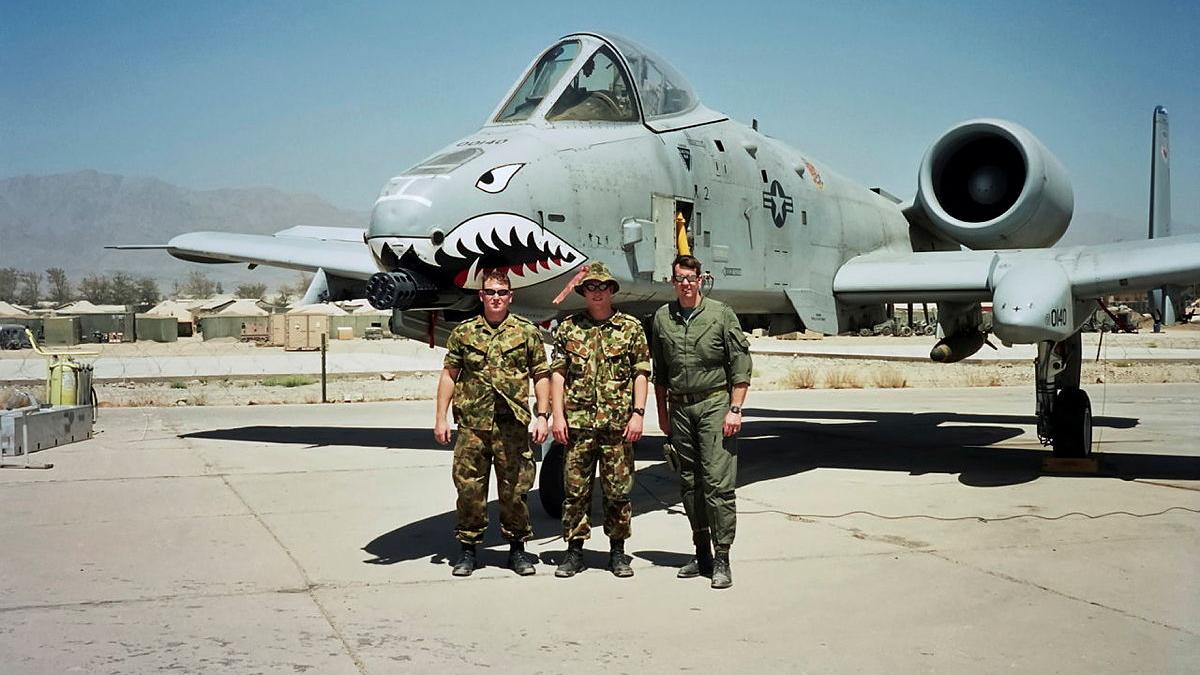
It was December 2001, just a few months after the 9/11 attacks. GPCAPT Stewart Dowrie, then a line pilot with 36SQN Flying School, was captaining a C-130H Hercules to Kuwait – his first flying mission under Operation Slipper.
As the aircraft departed Kuwait, having delivered missiles, armaments and other essential combat supplies to Australian special forces, a loadmaster noticed a significant fuel leak from one of the external tanks.
“That forced us to dump fuel until the leak stopped and return to Kuwait,” GPCAPT Dowrie said.
“There’s nothing like having an airborne emergency, landing safely and then being told you have to get out of there, because they weren’t convinced it was going to be safe for us to stay.”
It was Ramadan but the US had continued military operations in Afghanistan unabated; a decision which exacerbated tensions in the region.
“So we were under some pressure to get out of there within 24 hours, which we ultimately did through some quick re-organising of the route back home,” GPCAPT Dowrie said.
The following July, he flew on his second Operation Slipper mission – this time into Afghanistan. The Afghan Northern Alliance, supported by the US, had captured key cities, including Kabul, by the end of November 2001. Australian Special Forces were now based at Bagram Air Force Base and continuing to support coalition efforts to defeat the Taliban.
“We were told that nothing outside 3 to 5 nautical miles outside of the airfield would be considered safe enough to fly at low level,” GPCAPT Dowrie said.
“The full array of MANPADs [man-portable air-defence systems] threats, small-arms fires and everything else looking to take out a low-flying military aircraft was ever present.
“But we used the full array of tactics and techniques that we had been trained in over the years to mitigate those types of threats.”
'So to be there right at the start is still quite special to me.'
That particular mission included ferrying a delegation from the Joint Standing Committee on Foreign Affairs, Defence and Trade, which was conducting a Watching Brief on the War on Terrorism. That involved time on the ground at Bagram, as well as night up in Kyrgyzstan to visit the 33SQN air-to-air refuelling detachment. There was also another resupply run into Bagram for the Australian Special Forces.
Apart from contending with the turbulence and high altitudes of eastern Afghanistan, that flying mission was uneventful.
“Ironically, I never actually got back to the Middle East after that,” GPCAPT Dowrie said.
“My career just took me in other directions. So to be there right at the start is still quite special to me.”
He described Afghanistan as the cornerstone of the ADF’s pivot into a combat mindset and that 36SQN was well prepared for that transition.
“It didn’t feel like we were going from peacetime directly into a war – we had been moving that way for some time. East Timor was probably more of that experience for others in the ADF,” GPCAPT Dowrie said.
“We had been involved in Cambodia evacuations in 1997, ready for Indonesia evacuations following the Jakarta riots in 1998 and then led the push into East Timor in September 1999.
“So by late 2001, the unit was pretty well prepared and it really did feel like a logical progression of our training to step into Afghanistan operations in 2002.”
When he had conducted his first flying mission, it was before the establishment of JTF 633 and there had yet to be a standing Australian presence in Afghanistan.
“The C-130 in particular has a reputation for being first in, last out,” GPCAPT Dowrie said.
“We went in there without the enormous backbone of RAAF, JTF or HQJOC and other organisational deployment mechanisms that would come to be established in later years. So we learned to be very resilient, self-reliant and very thankful for the support we received from our US allies.
“I think as we look forward to what we might have to deal with into the future, we’re going to have to use that same notion of self-reliance, working with what we’ve got, with what we own already.
“We can’t worry too much about what somebody might bring to us in two or three years, because it’s never going to be there in time.”

Related stories


