Art helps soldier see life in a new light
With an uncle who served in the 1 Armd Regt, Pte Andrew Bradshaw knew from an early age that he wanted to join the Army.
“He’d always been a massive inspiration to me, so I followed in his footsteps and joined the Army just after turning 18,” Pte Bradshaw said.
After completing training at the School of Infantry in Singleton, he was posted to 7RAR in Adelaide as a rifleman. He later deployed to Butterworth, Malaysia, and is now serving at Robertson Barracks in Darwin following the merger of 7RAR with Darwin’s 5RAR.
The move to the Northern Territory was not easy.
“I’d made a lot of friends in Adelaide, and my family are down south,” Pte Bradshaw said.
“That caused a number of mental health challenges, and I was also medically downgraded, so after four years of service, I’ll be leaving Defence in December and moving back to Adelaide.”
While working through those challenges, Pte Bradshaw received support from Open Arms, unit chaplains and psychologists, but it was a colleague named Oscar who encouraged him to join the ADF ARRTS program.
ARRTS stands for Arts for Recovery, Resilience, Teamwork and Skills. It is a four-week live-in program held twice a year at the University of Canberra, where experienced mentors teach music, creative writing and visual arts techniques to help participants discover new outlets and enhance their wellbeing.
“Oscar said it was excellent and had helped guide him from infantry into photography through the visual arts stream,” Pte Bradshaw said.
Like Oscar, Pte Bradshaw chose visual arts, again inspired by his uncle, who was a prolific drawer, painter and Warhammer player.
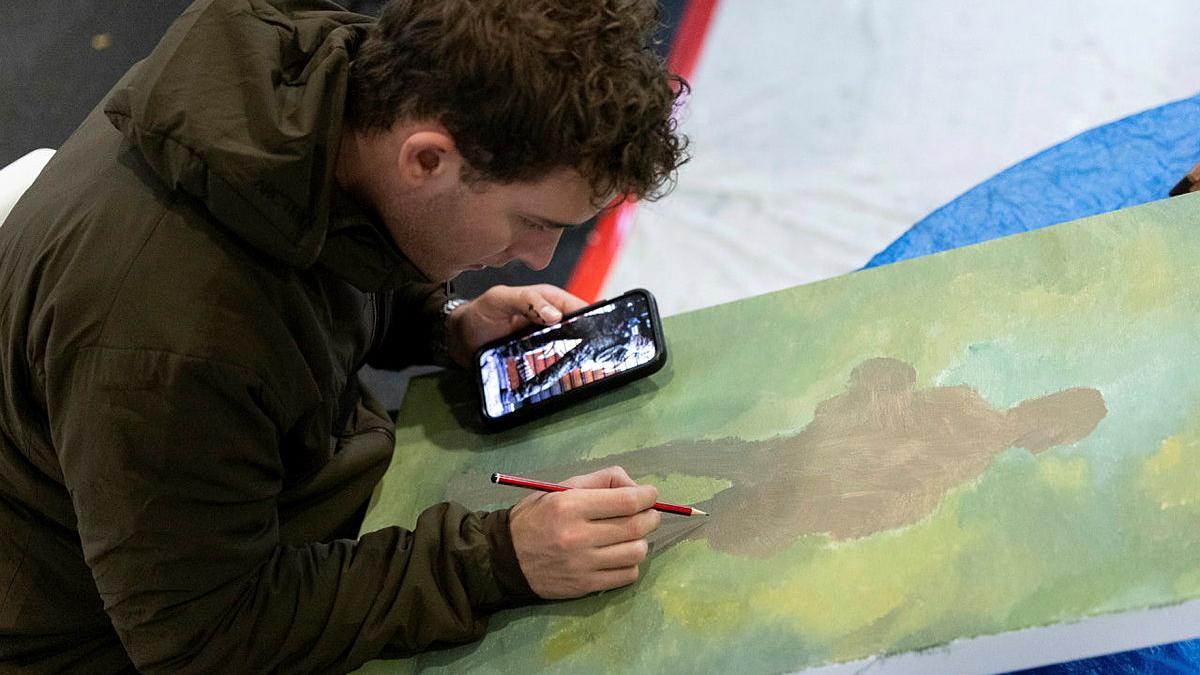
“I’d only ever done drawing as a kid, but during the program I was amazed to discover I could actually do oil painting because I’d never tried it before,” he said.

His major work was based on a photograph of himself in Army camouflage, which he recreated on canvas to the delight of the visual arts mentors.
“It was wonderful to receive so much encouragement from skilled professionals, and I’ll definitely continue developing my oil painting skills,” he said.
Pte Bradshaw said the program also supported his personal development.
“It helped with some of my struggles because I can feel stressed and overwhelmed when I’m not accomplishing things, and at times my Army role left me feeling that way,” he said.
“I also think that this kind of work can be of tremendous value in combat because success in battle can be helped by thinking a bit more creatively about what you’re trying to accomplish.”
Every ARRTS program ends with a celebration showcase attended by family and friends, where participants perform music, present poetry, read stories and display their artistic creations.
Among those attending was Pte Bradshaw’s girlfriend, Amy, who travelled from Darwin to support him and was impressed by the artistry on display.
“She loved my painting and is keen for me to keep pursuing it when we move back to Adelaide and I begin a new career in private security,” he said.
“I’m also really glad that we’ll no longer miss out on seeing my little brother and sister growing up, which was an unfortunate outcome of being moved to Darwin.”
Along with the other participants, Pte Bradshaw stayed at the accommodation centre, which provided opportunities for social interaction beyond the program sessions.
“I had a small room to myself and, because I brought my laptop, I was able to play video games every now and then, alongside going out for a few dinners and lunches with the others,” Pte Bradshaw said.
“For many of us, our social batteries felt quite drained during the first week, and it was great that people could retreat to their rooms and have some alone time.”
'You learn a lot about yourself and how to interact with others, and it’s reopened the creative side of my brain, which is a really positive thing that I’ve brought back to the workplace.'
As the program progressed, friendships formed among participants from different services and backgrounds.
“I think getting to know people from other backgrounds is really important, rather than just sticking with your own corps or service,” he said.
“It broadens your perspective and opens your eyes to different experiences.
“This especially applies to us in the infantry because we’re sometimes too offensive for others, or we’ll make jokes about things you can’t make jokes about, so it can be hard to find the middle ground.”
Pte Bradshaw said the program provided a range of benefits and would be valuable for many people.
“You learn a lot about yourself and how to interact with others, and it’s reopened the creative side of my brain, which is a really positive thing that I’ve brought back to the workplace,” he said.
“And mindset-wise, I’m definitely seeing things in a new light and am very grateful for this unique opportunity.”
The next ADF ARRTS program will be held in Canberra from November 1 to 27. Applications are open until September 28.
For more information, email adf.arrts@defence.gov.au, visit defence.gov.au/arrts, or call 02 6127 6505 during business hours.
Related stories


