Pharmacy careers outside the box
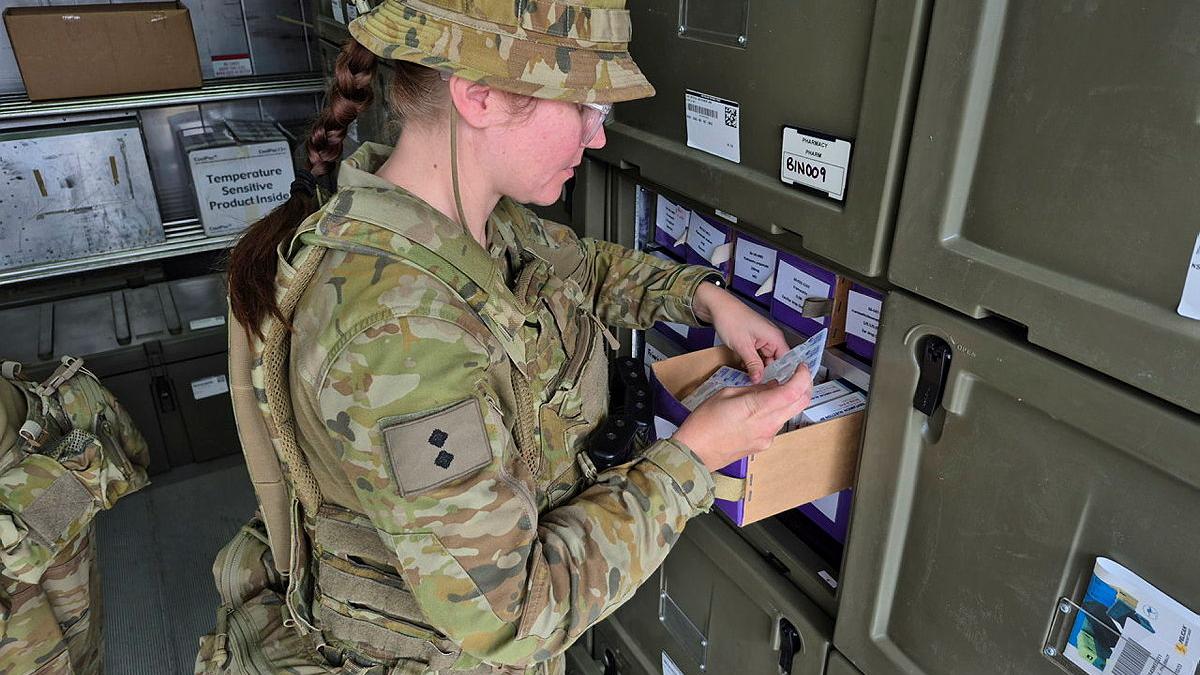
Pharmacists are not typically the first profession associated with military health, yet their contribution is critical.
From optimising medication use and providing advice on the introduction of new classes of Navy ships to supporting healthcare delivery on operations, pharmacists play a vital and diverse role in sustaining the health and readiness of ADF personnel.
For many pharmacists, it is this breadth of work that makes Defence an appealing employer, with diverse postings and opportunities extending far beyond the traditional pharmacy setting.
Capt Chloe Ivak completed her pharmacy degree through Defence’s sponsorship pathway and is now in her fourth posting, at the Maritime Operational Health Unit, and routinely deploys on board Navy’s Canberra-class ships HMAS Canberra and HMAS Adelaide.
When the ship is alongside, she works from the ship's dispensary as part of the medical team. When the ship deploys on exercise or operation, her role expands as the health team transitions to a larger Role 2 treatment facility where she undertakes responsibilities more closely aligned with hospital pharmacy practice.
“Defence gives you a lot of variety in terms of moving around the country, seeing different patients,” Capt Ivak said.
“So far I’ve worked in three very different pharmaceutical areas in Defence ranging from logistical to clinical, which is something that not many people in this early stage of their pharmacy career can say.”
'I’ve compounded lots of creams before, but I just never imagined that compounding oxygen would be in my repertoire.'
Sqn-Ldr Kara Sellwood took a different pathway into Defence, joining RAAF after a decade managing community pharmacies across Queensland and New South Wales.
During her 12 years in Defence, Sqn-Ldr Sellwood has had the opportunity to deploy on multiple exercises and operations, including Exercise Pacific Angel in the Philippines, a United States Air Force-led humanitarian health activity that saw military personnel establish a temporary primary healthcare clinic in a gymnasium to provide care to the local community.
She has also deployed to the Middle East on several occasions, serving in Iraq and at Al Minhad Air Base (AMAB).
“My role in the Middle East was quite similar to what you would expect a garrison pharmacy to look like. The main role was dispensing and providing over-the-counter advice.”
“However, when I was at AMAB in early 2021 it was the height of COVID outbreaks, before vaccines were available, so I also spent a lot of time helping the scientific officer run the PCR machines for all the testing we were doing on the base.
“When we finally got the vaccines, I was involved in the mass vaccination rollout.”
In the Northern Territory, Flg-Off Giovanni Farag is based at Tindal Health Centre as part of a multidisciplinary healthcare team including doctors, nurses, medics, physiotherapists, occupational therapists, dentists and other health professionals.
Flg-Off Farag said one of the aspects he enjoys most about his current role is being involved in patient care decisions as they are being made.

"In many civilian settings, pharmacists often receive a prescription once the decision has already been made,” he said.
“In Defence, similar to hospital pharmacy, I have the opportunity to collaborate directly with clinicians and influence treatment decisions in real time to optimise patient outcomes."
While Defence patients are generally much healthier than those seen in civilian practice, there are additional operational considerations that add another layer of complexity and problem-solving.
"We also need to consider operational requirements. Can this person deploy while taking this medication? Will it affect their ability to fly, drive military vehicles, carry weapons, undertake shift work, or operate in remote environments?,” Flg-Off Farag said.
Lt Cyndi Scholes, meanwhile, is posted to a more logistics-focused role in the 3 Health Bn, where she is primarily focused on supporting the unit's surgical and close health capabilities by preparing medicines and medical consumables required for training activities, exercises and operations, including restricted Schedule 8 medications.
She is passionate about expanding pharmacists’ scope of practice and recently undertook training in oxygen compounding.
“I know that Army is trying to think of different ways that we could better sustain oxygen when we are in the field,” Lt Scholes said.
“I’ve compounded lots of creams before, but I just never imagined that compounding oxygen would be in my repertoire.
"In civilian pharmacy there's a lot of discussion about expanding scope of practice. In Defence, that conversation is sometimes more relevant because the workforce is relatively small and people often need to wear multiple hats.”
'In Defence, similar to hospital pharmacy, I have the opportunity to collaborate directly with clinicians and influence treatment decisions in real time to optimise patient outcomes.'
Outside her core duties, Defence has offered Lt Scholes opportunities to develop a broad range of military and leadership skills.
"I'm a pharmacist, yes, but I'm also an Army officer," Lt Scholes said.
"I get to ride in military vehicles, handle weapons, participate in stretcher carries and work alongside teams with a wide range of specialist roles.”
In Defence, pharmacy can even be a starting point for a much broader career, with pharmacists able to take their skills and experience into a range of healthcare, leadership and operational roles.
Leut Luke Parsons joined Navy as a direct-entry reserve Health Services Officer after 15 years of civilian practice, and is currently on SERVOP C as Practice Manager at Kuttabul Health Centre.
This role requires skills gained during his pharmacy career to support the delivery of healthcare and show the utility of the Total Workforce System (TWS), which enables Defence to access and employ specialist skills from a flexible workforce through differing reserve service categories.
"The military in general, but particularly the Navy, would not have a full healthcare capability without all service categories of the TWS working together,” Leut Parsons said.
“I'm very passionate about building part-time capability, integration and helping ensure they are ready to deploy at short notice.”

Leut-Cmdr Graham Sheehan has also applied his pharmacy expertise in a range of maritime health and capability roles, including as a member of the advisory team that helped bring the Navy's Canberra-class ship’s hospital capability into service.
In that role, he provided specialist advice on medicine management and pharmaceutical storage requirements in the maritime environment.
"Each ship and platform has a different function. They're all different sizes, and the way they store equipment and supplies varies, so it's important from a pharmaceutical perspective, particularly when managing cold-chain medicines, to understand how they're configured," he said.
His career has taken him across a diverse range of Navy platforms, from patrol boats to submarines, exposing him to unique areas of medicine.
"I got to learn about gases and the pharmaceutical aspects of hyperbaric medicine, which was very interesting," Leut-Cmdr Sheehan said.
For pharmacists considering a career in Defence, Flg-Off Farag recommends doing research and asking Defence Force Recruiting to connect them with current Defence pharmacists before making the decision to join.
“Like any organisation, Defence has both rewarding and challenging aspects,” Flg-Off Farag said.
“You need to be prepared for everything from highly desirable postings and unique opportunities through to remote locations, separation from family, and potentially supporting operations or conflict.”
While the role may not be suited to everyone, Capt Ivak believes it is particularly well suited to those who are “keen to roll up their sleeves and give things a go”.
Lt Scholes agrees.
“If you want a challenge and you want to think outside the box, go for it,” she said.
Related stories


