Drones set to enhance combat capability
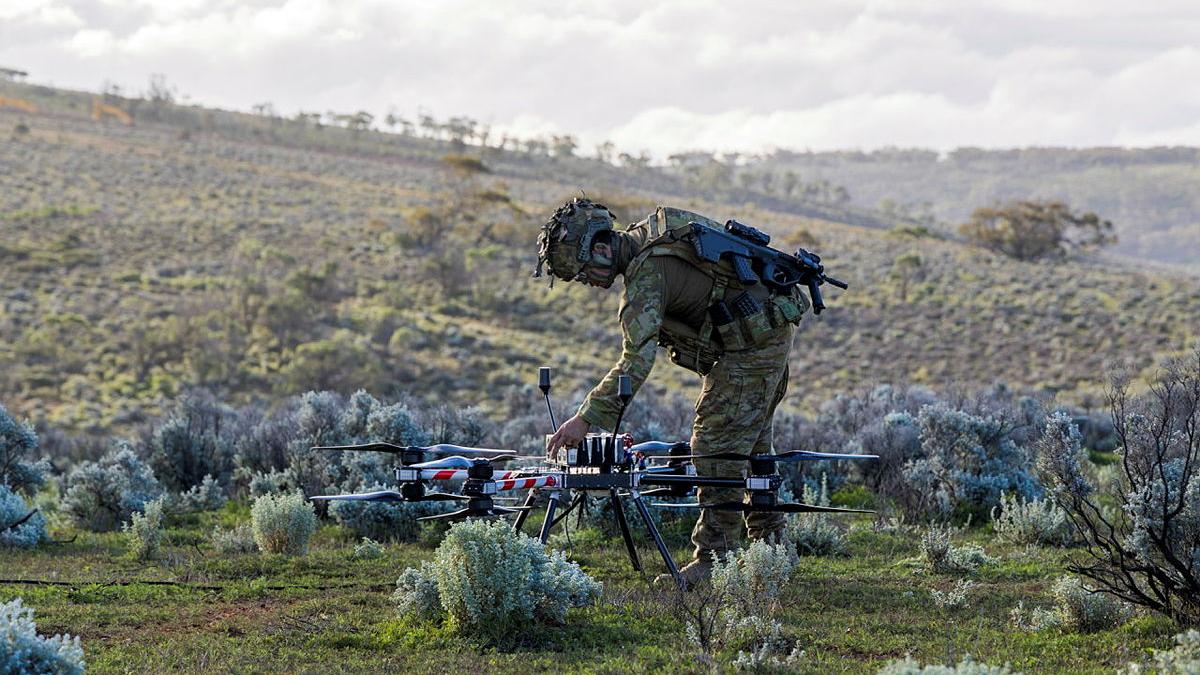
First-person-view strike drones will soon be part of infantry’s arsenal, with 5/7RAR aiming to field a fully integrated combat team for Talisman Sabre 2027.
Leading the initiative, they’re also trialling additional capabilities, including reconnaissance drones and unmanned ground vehicles.
Commanding Officer 5/7RAR Lt-Col Ash Zimmerlie said robotics and autonomous systems (RAS) would not replace soldiers, who would still patrol, infiltrate and conduct offensive and defensive operations, but would instead enhance those functions.
“We will simply be more agile and lethal,” Lt-Col Zimmerlie said.
Alpha Company has spent the year training and qualifying soldiers in RAS, trialling and acquiring equipment, and developing procedures for light infantry.
Next year, those specialists will integrate back into other rifle companies, creating Army’s first RAS-ready battle group, with plans to spread those skills to the rest of 1 Bde and beyond.
While the brigade is responsible for offensive RAS capabilities, 7 Bde is also working on counter-RAS technologies.
Separating development allows for a more efficient trial and integration phase, with both capabilities to be shared across Army once established, according to Lt-Col Zimmerlie.

“If we want to stay in the game and stay in the fight, we need to keep pace with the accelerating and changing character of war,” Lt-Col Zimmerlie said.
“All of our peer adversaries and allies have adopted this technology, and we must do the same.”
According to the Council on Foreign Relations, a non-partisan US think tank, drones dominate Ukraine’s frontline kill zone, reportedly causing 75-85 per cent of casualties.
OC Alpha Company, Maj Nic Alexandrou, said the widespread use and effectiveness of drones in current conflicts was shocking.
“Concealing and protecting vehicles, emplacements and high-value hardware is going to be a pressing challenge moving forward as RAS-enabled dismounted patrols become exceedingly lethal,” Maj Alexandrou said.
Recently, on Exercise Black Prince, 5/7RAR worked with Army’s experimentation unit, 1 Armd Regt, demonstrating FPV drone strikes at ranges well beyond what typical off-the-shelf drones can achieve.
These exercises are designed to determine what is fit for purpose and what is not.
This helps decision-makers to discontinue unsuitable projects or provide funding for effective technologies.
'If we want to stay in the game and stay in the fight, we need to keep pace with the accelerating and changing character of war.'
Pte Jack Pilgrim, one of the 5/7RAR FPV operators, said strike teams could provide commanders with strike or reconnaissance.
He used the example of an anti-armour team, which traditionally hauls heavy equipment and positions itself relatively close to the enemy to achieve a kill.
“With the right equipment, we can sit ages away and drop multiple FPVs on targets in minutes, and they’ll have no idea where they came from,” Pte Pilgrim said.
Drones can also be flown ahead of a patrol, spotting enemy forces in advance, providing options for ambush or avoidance, depending on the enemy’s size.
Pte Pilgrim said a focus was optimising the technology for light infantry, including minimising and distributing equipment loads, as well as finding power solutions.
Meanwhile, the proliferation of drone-mounted light and thermal sensors make staying out of sight more challenging.
Maj Alexandrou said concealment was not a thing of the past, but something requiring adaptation.
For example, when camouflaging a position, such as an observation post, soldiers now need to place emphasis on observation from the air as well as the ground.
“It’s more difficult and there’s more involved, but the same fundamentals of concealment still apply,” he said.
“You just have to acknowledge there will be cameras in the sky that can see very well at night.”

Related stories


