From keen eyes to sharp talons
When 2 Cav Regt adopted the wedge-tailed eagle as its badge 56 years ago, it was drawn to the bird’s “keenness of sight and ability to roam large distances” – qualities that mirrored the regiment’s reconnaissance role.
More than half a century later, the comparison has evolved. A sweeping modernisation program is delivering the regiment with its greatest lethality and fighting capability in decades, drawing parallels to the winged raptor’s powerful talons designed to rip prey apart.
CO 2 Cav Regt Lt-Col Joshua Higgins has witnessed the transformation first-hand.
“If you go back to when I first joined the Army 24 years ago, we received one piece of new technology every decade. Now there’s over a dozen new systems coming in to Army that make us extremely modern and lethal,” Lt-Col Higgins said.
“2 Cav traditionally has been quite iterative and evolving. For at least the last decade, we’ve adapted, adopted and trialled new technologies and new systems.
“But the current window is a time when a lot of these are at a maturation point, where we’re bringing them together.”
While 2 Cav Regt’s reconnaissance and security mission has remained unchanged, Lt-Col Higgins said the capabilities used to perform that role had changed significantly.
The regiment’s role is to provide commanders with early warning through aggressive patrolling, observation, screening and fighting for information.
'Now there’s over a dozen new systems coming in to Army that make us extremely modern and lethal.'
In the past, that mission was carried out with no more than a vehicle, a weapon system and a set of binoculars.
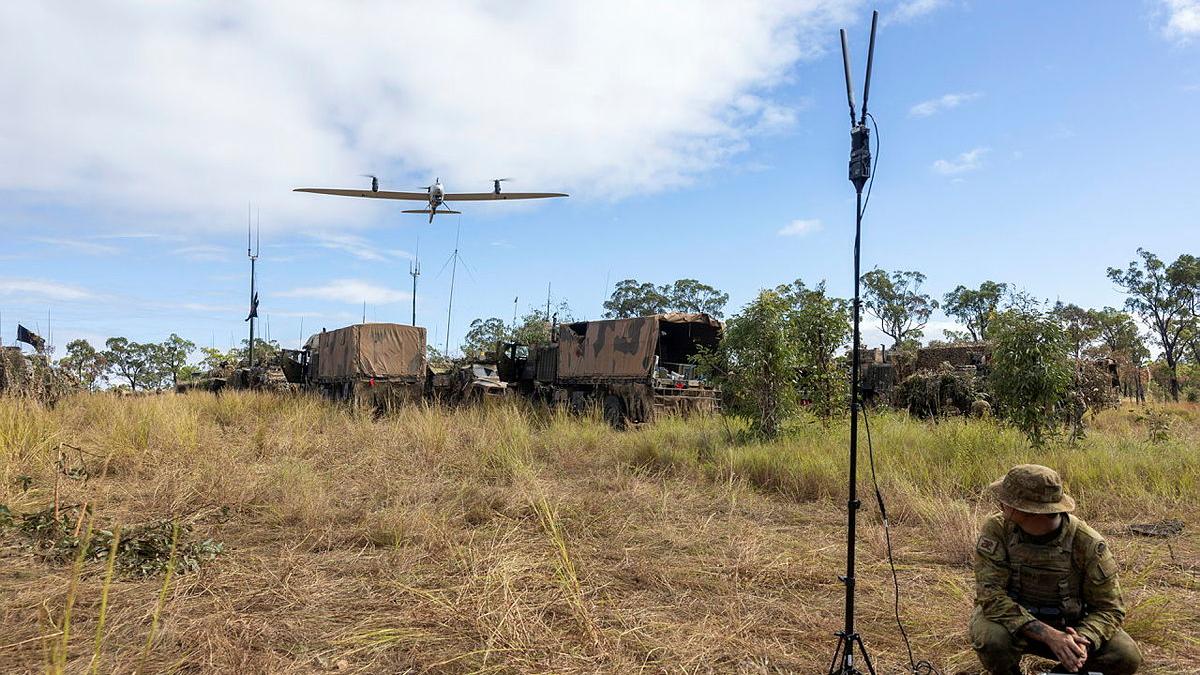
Today, crews conduct patrols armed with drones that can project sensors kilometres beyond the vehicle; employ passive sensing capabilities that can identify enemy signatures; communicate information over long distances using state-of-the art communications suites; and plug directly into a digital targeting network that enables them to carry out long-range strikes, keeping personnel safely dispersed and at distance.
The regiment’s combined arms team has a fire control system able to integrate with other Army elements such as the new AS9 Huntsman self-propelled howitzers, to fire via a cavalry troop onto target.
Crews now carry long-range ISR drones and payload drones, and are able to strike targets beyond the range of cannons they would normally just shoot.
“Imagine being able to find a person or a vehicle-sized target further away than you could walk in a day, then be able to tell someone about it 30 kilometres from where you are, in seconds,” Lt-Col Higgins said.
“Then imagine being able to track that target continuously, even after it disappears from physical view, being able to watch where it goes and then being able to strike it from a distance that keeps your people in a position of safety. We can do that now.”
Innovation has also extended to the tank side of the regiment, with integrated drones able to ‘see’ over a ridge line before a tank crew commits to a location or a target ambush.
Lt-Col Higgins said his soldiers had impressed with how they had adapted to the modern operating environment and were “getting after” the new technologies they’ve now got.
The next chapter of 2 Cav Regt’s evolution is likely to be the augmentation with uncrewed ground systems.
“Like our mascot, we have a keen eye that allows it to hover above targets at great distances, but then it also has a set of serious talons behind it that can fly in and attack its prey, and that is the merit of cavalry,” Lt-Col Higgins said.

Related stories


