AI a new tool for drone pilots
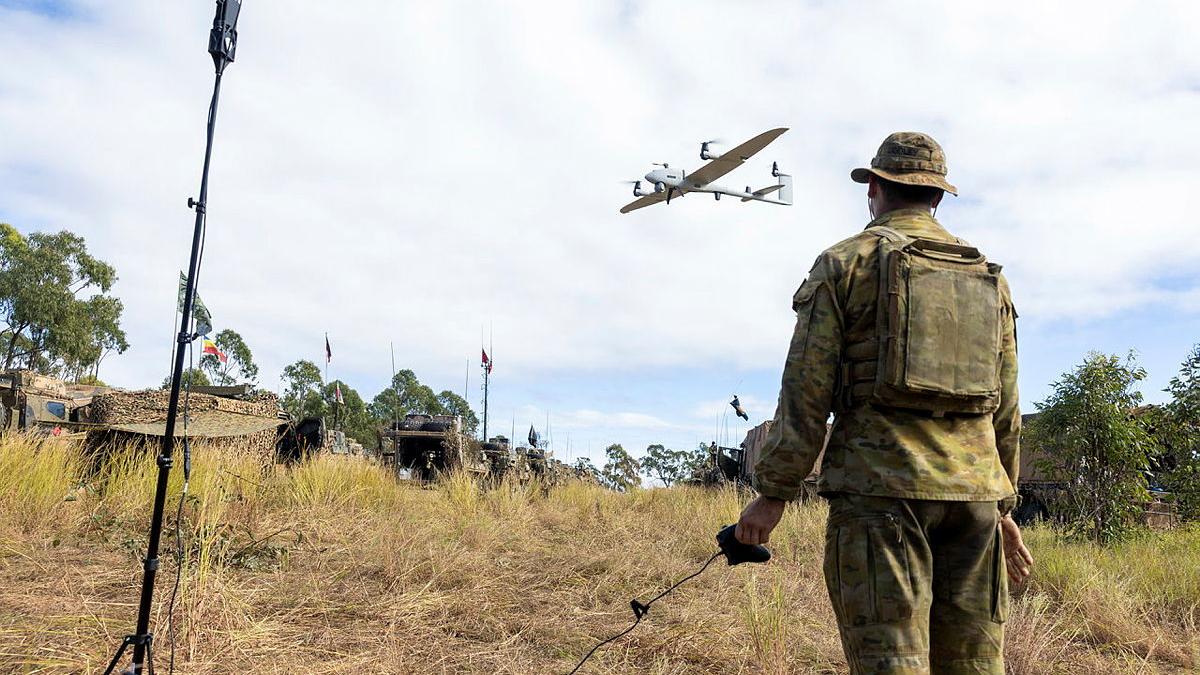
One of Army’s newest fixed-wing reconnaissance drones took flight on Exercise Southern Jackaroo, identifying targets in depth and enabling drone and artillery strikes on enemy positions.
The Vector AI, made by Quantum Systems, can map environments in real time and uses AI-enhanced software to detect and track objects while flying more than 60 kilometres.
Drone pilot Cpl Harrison Hinson, of 2 Cav Regt, said his unit would normally identify the enemy through mounted and dismounted reconnaissance, using direct observation.
“This also means that we would be putting our soldiers in direct fire range and at risk of compromise,” Cpl Hinson said.
“With our employment of drones, we have one more tool at our disposal to enhance our reconnaissance and strike capabilities.”
Having flown fixed-wing drones since 2022, Cpl Hinson focused on understanding the new platform’s strengths, limitations and capabilities.
The Vector AI, with a wingspan of 2.8 metres, uses tiltrotors – similar to the MV-22 Osprey – to transition between vertical and forward flight, giving it the hovering capability of a helicopter with the speed and range of a fixed-wing aircraft.
“The flying side is quite easy if you have flown other systems,” Cpl Hinson said.

Because fixed-wing drones can penetrate deeper into enemy lines, they excel at providing information that helps friendly forces disrupt rear elements, degrading an enemy’s ability to coordinate and resupply forward units.
That same information shortens kill chains – the steps taken in finding targets and destroying them – enabling faster offensive action. Cpl Hinson said offensive use of the technologies had informed how they operated defensively.
“We have to assume we are always being observed and need to better ourselves on how to hide or disguise our signatures,” he said.
The Vector AI comes from a lineage of drones used in Ukraine and other conflicts, with each upgrade shaped by thousands of mission hours across global military operations.
Related stories


