A game changer for medics
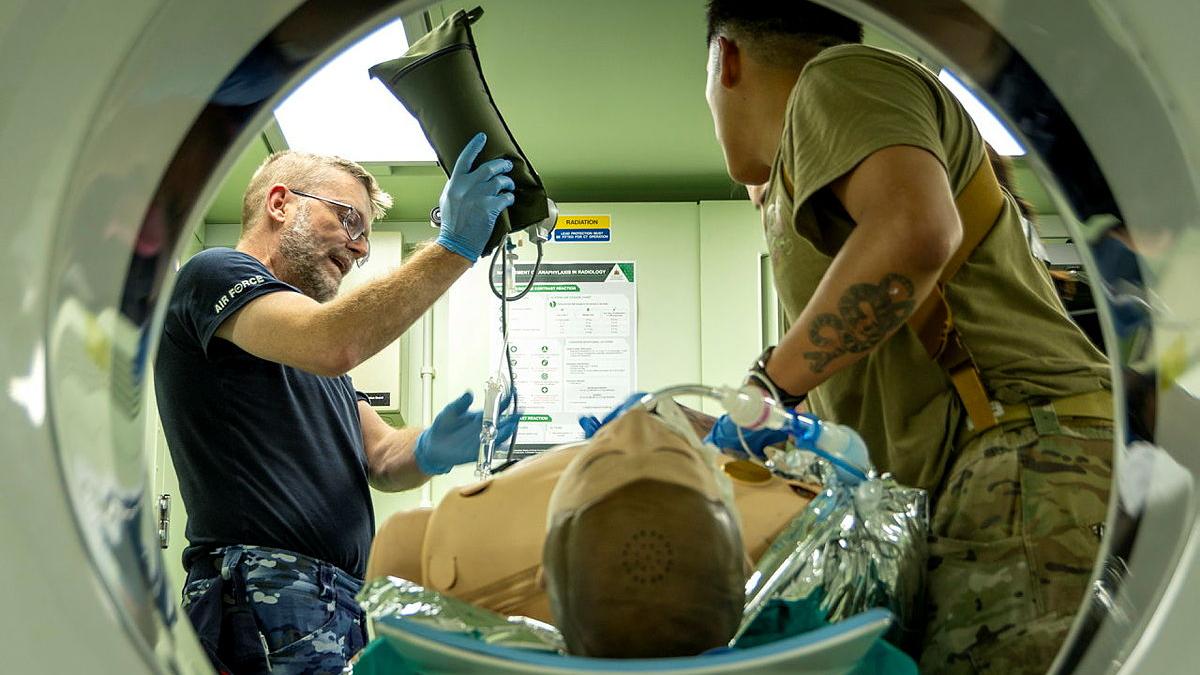
It's widely regarded as one of the most important medical innovations of the past 50 years, earning its inventor – British engineer Sir Godfrey Hounsfield – a Nobel Prize, and revolutionising the world of medical science.
So it’s no surprise the ADF celebrated its first use of a deployable CT scanner on a field exercise as a significant breakthrough.
Health care personnel were demonstrating their medical skills and capabilities on Exercise Viper Walk.
Led by 2 Health Bn, soldiers operated out of multiple locations, cooperating with counterparts from the RAN, the RAAF, the NZDF and the US Air Force.
While smaller elements at Holsworthy and Canungra provided close and integral support to casualties nearer the front, three surgical elements operated out of 2 Health Bn’s home base of Gallipoli Barracks, from Role 2 Forward (R2F) and two Role 2 Enhanced (R2E) field treatment facilities.
CO 2 Health Bn Lt-Col Zachary von Bertouch said running the two simultaneously was a challenge.
“Everyone is involved. We have a split SERCAT 5/SERCAT 7 workforce, we have clinical specialists, support staff that do logistics as well as electrical engineering, so the whole team is involved in coming together for this exercise,” Lt-Col von Bertouch said.
‘The scanner can be used for lots of scenarios, from a walking, talking patient who’s come in with abdominal pain, to the extremities and musculoskeletal fractures. But it comes into its own with the more critical casualties.’
Embedded within the R2E – the highest level of care generated by 2 Health Bde – the CT scanner generated cross-sectional imaging of patients, providing clinicians with high-quality, three-dimensional pictures of an injury or illness, which are far superior to an X-ray.
Maj Gabrielle Grant, the Army’s senior radiographer and one of the driving forces behind its use by the ADF, said it was a big achievement.
“The scanner can be used for lots of scenarios, from a walking, talking patient who’s come in with abdominal pain, to the extremities and musculoskeletal fractures. But it comes into its own with the more critical casualties,” Maj Grant said.
“If there are questions about what the diagnosis might be, we can get them in here, get that really accurate information, and maybe we can avoid taking them to the operating theatre or change their evacuation priority, so that’s a great step forward.”
But, there are challenges involved in moving, operating and powering a piece of large hardware in a tactical environment.
“Given the size and the weight of this capability, the transport requirements are significant,” Maj Grant said.
“The CT scanner container weighs 11.5 tonnes. The other big logistics challenge is the power and fuel requirement.”

There are also additional training requirements for operating such a highly specialised capability under field conditions.
“Because it’s an advanced clinical modality, we have to make sure our radiographers have the right skillset, not only to use it clinically, but to assist the many other skilled trades in Defence who help convert it from a container on a truck into a working scanner,” Maj Grant said.
The field room was different from a civilian setting.
“You’re a lot more closed in, the atmosphere is a bit more intense, you’ve got trauma patients coming in, you’re sliding them across, and the noise is amplified,” she said.
Another innovation on the exercise was the placement of one of the two R2E treatment facilities in an urban environment, reflecting the reality of some conflicts on the world stage.
An R2E is a small hospital, providing more complex surgeries, emergency resuscitation, intensive care and recovery wards, together with allied healthcare services needed to keep a deployed force in the fight.
Lt-Col von Bertouch said it was about testing different options to increase survivability.
“The current modern operating environment means that sometimes setting something out in the open, with a large red cross on the roof, isn’t survivable,” Lt-Col Bertouch said.
“So for us it’s about testing different options to increase our survivability.”
Related stories


