Reservists look and learn on course
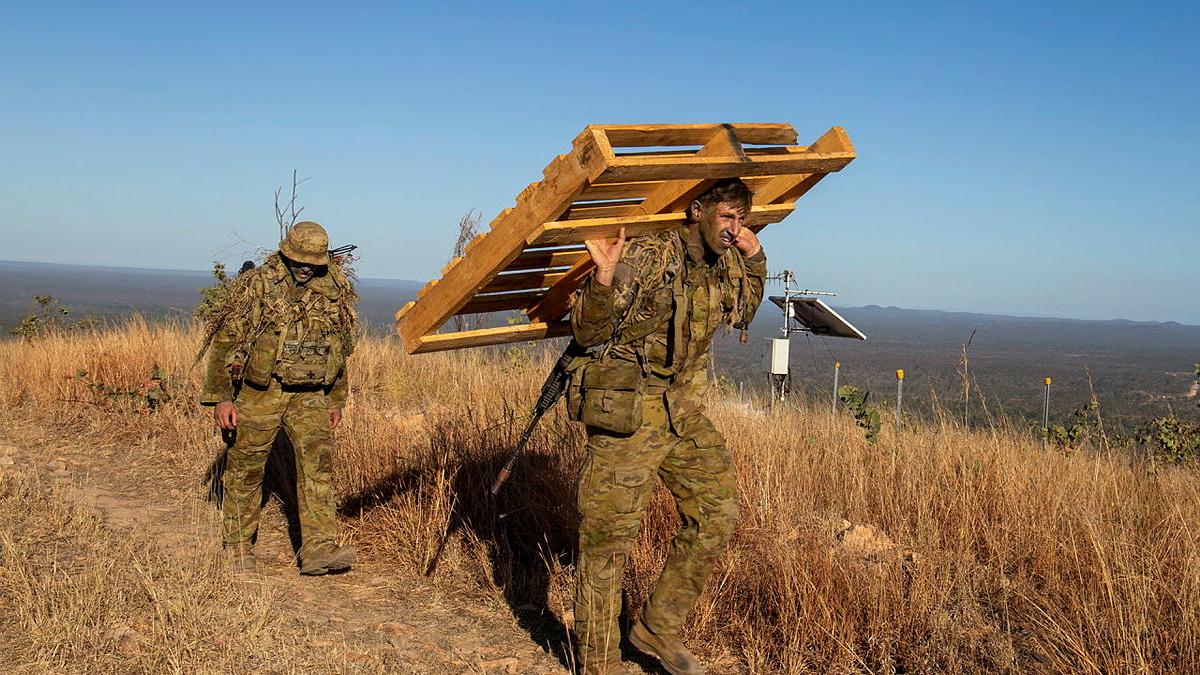
Reservists from across Australia spent almost 30 days in the field demonstrating the teamwork, resilience and adaptability needed to deliver reconnaissance capability and support homeland security operations.
The 28 soldiers completed the basic reconnaissance course conducted by 31/42RQR at Townsville Field Training Area from August 29 to September 27, conducting surveillance and reconnaissance tasks, navigating across complex terrain, and reporting accurate, timely information.
While the course develops soldiers’ confidence operating in small teams, CSM Bravo Coy WO2 Matthew Solis said its value was much broader.
“It instils self-reliance, resilience and attention to detail,” WO2 Solis said.
“These courses matter because they create a culture of continuous improvement. Soldiers learn to push through discomfort, trust their training and operate under ambiguity.”
CO 31/42RQR LTCOL Merrick Lalor said the course aimed to not just return qualified soldiers to their parent unit but to strengthen calibration across 2 Div reconnaissance elements, building interoperability and establishing common reconnaissance standards.
“When soldiers from different elements work from the same baseline SOPs, TTPs and principles, they are able to integrate much faster – which means less time establishing how the team will operate and more time focusing on the mission,” LTCOL Lalor said.

'That is what makes a 2 Div reconnaissance patrol formidable. You are not simply building six soldiers. You are combining six different sets of experience into one team.'
For Army, that means a broader pool of reconnaissance-qualified soldiers who can integrate across units, and provide commanders with timely information to support decision-making.
The course builds that capability by taking soldiers back to warfighting fundamentals before progressively increasing complexity and requiring them to perform under fatigue and uncertainty.
WO2 Solis said soldiers on the course demonstrated resilience and determination.
“The way they looked after each other, sharing the load, lifting each other up during the hard moments, was exactly what we want to see in soldiers,” WO2 Solis said.
Kennedy Coy training warrant officer WO2 Paul Harrison said bringing together reservists from a range of backgrounds and experiences also provided a significant capability advantage.
“In a six-person patrol you might have a mechanic, an underground miner, a civilian drone operator, an IT engineer, an electrician and an Australian Border Force commander,” WO2 Harrison said.
“Then add military attributes such as fitness, mental resilience, leadership, navigation, superior observation, calmness under pressure and strong infantry fundamentals. Individually, those skills are valuable. Combined within a disciplined reconnaissance patrol, they become extremely powerful.
“That is what makes a 2 Div reconnaissance patrol formidable. You are not simply building six soldiers. You are combining six different sets of experience into one team.”

Related stories


