Army health experts prepare for the heat of battle
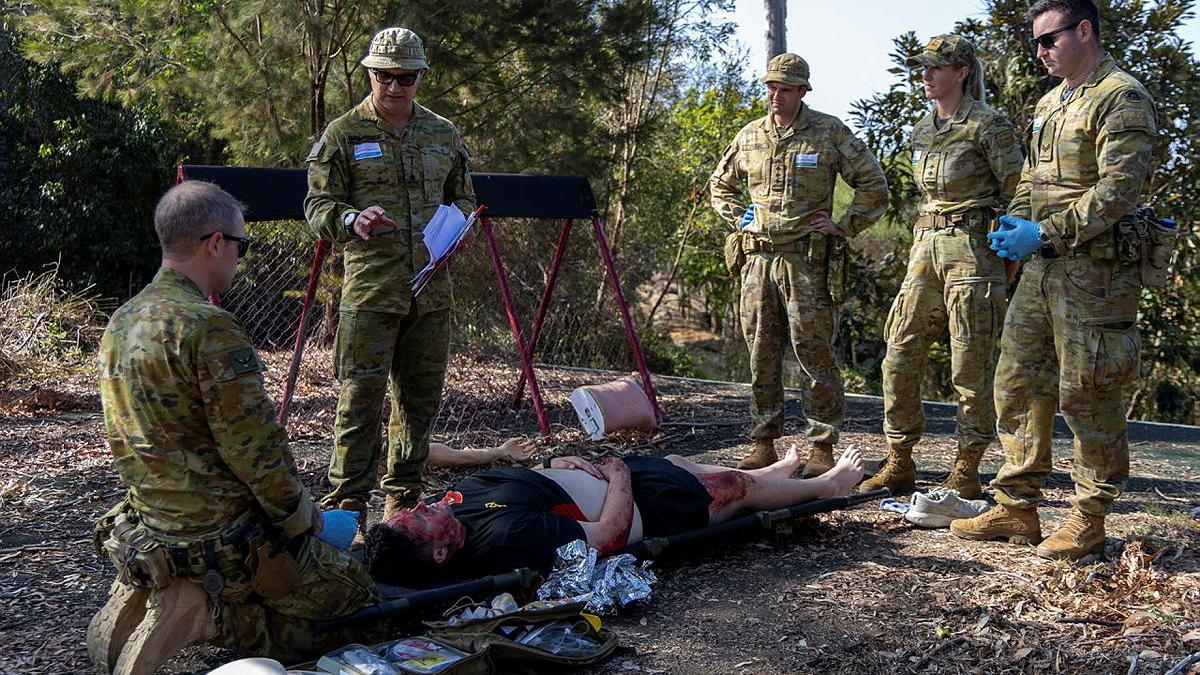
Of all the injuries Army health personnel may face in their careers, burns are among the most challenging.
Intensely painful and uniquely prone to infection, if not controlled at an early stage they can pose an imminent threat to life – particularly in austere environments, where resources are scarce and definitive care may be a long way off.
This is the thinking behind a new ADF Emergency Management of Severe Burns (EMSB) course, based on an existing course run by the Australian and New Zealand Burns Association – which is considered the gold standard in civilian medicine.
The driving force behind the initiative is Col Keith Towsey, Deputy Commander of 2 Health Bde and a burns and trauma surgeon in his civilian practice.
He said the aim was to give students the critical knowledge they would need to save lives on the battlefield.
“The idea really is to improve their understanding of burns in the military context, how different types of combat dictate the number of burns patients will suffer, but also to get them familiar and comfortable with the patterns of injuries they’ll see with burns, how to assess wound depth and the size of the burn, because that dictates resuscitation,” Col Towsey said.
Apart from a conventional classroom component, medics, nursing officers and doctors were put through a series of realistic tactical simulations.
“They’re working in the field, it’s a fairly hot day, they’re in their SCE, and that's designed to mimic some of the physical stress they’re expected to deal with in real combat. I think that’s something that’s been sort of lacking in the training to date,” Col Towsey said.
“Likewise, the group training scenarios will simulate the austere environment our clinicians are expected to operate in, which is very different from an air-conditioned civilian hospital environment, particularly in terms of physical comfort and access to resources and specialist care.”

Another element is familiarising Army health professionals with the sights and sounds that come with a severe burn – something that can be intensely traumatic, even for the most seasoned clinicians.
“Burns can be so confronting. It’s the most visually striking pattern of injury. The smell of burns in particular can be quite emotionally draining. So there’s a real risk that clinicians can get distracted from more seriously life-threatening but more subtle injury patterns,” Col Towsey said.
“Burns compared to, say, gunshot wounds or fragmentation injuries, kill more slowly over a period of days to weeks, whereas those other injuries kill within minutes.”
According to Maj Patrick Weinruch, an orthopaedic surgeon who serves with 2 Health Bn, the prevalence of burns on operations makes these skills even more critical from a Defence perspective – particularly as the Army shifts its focus to littoral operations.
“In a military context, burns are incredibly important. If we look at maritime ops and large-scale littoral combat operations, the traditional burn casually rate is approximately 20 per cent. The mortality rate, particularly with larger burns, and with cases we can’t evacuate easily, is extraordinarily high,” Maj Weinruch said.
“With armoured warfare and mounted ops, we’re probably talking about a 10 per cent burns casualty rate, and with dismounted troops we’re talking about 5 per cent, so even in those environments, burns still remain prevalent, and all of our soldiers are going to be exposed to that risk at some stage.”
It’s a point reinforced by Col Towsey.
“If you look at Ukraine in the early phases, where it was armoured manoeuvre warfare, about 10 per cent of combat casualties were burns, which is remarkably consistent across conflicts like the Yom Kippur War, the early and middle phases of the 2003 Iraq War, and the Second World War. Those numbers don’t change, irrespective of advances in technology,” Col Towsey said.
For Capt Stephanie Besley, a nursing officer at 2 Health Bn and the key coordinator for Defence EMSB courses, the most rewarding part of the job was seeing students from a range of different clinical backgrounds working together, and learning in a single day the skills they may need to save a life on the battlefield.
“One of the strengths of this course is that it brings the different SERCATs together. For example, we have anaesthetic doctors who do burns care day in, day out. They’re able to share their experience with the whole team. We also have SERCAT 7 members who are very strong in their ‘green skills’, and so they can learn from each other,” Capt Besley said.
“It really empowers our health professionals to make a difference. It’s literally eight hours of burns care, and they walk away from these schools knowing what to do in an emergency situation.”

Related stories


