Building confidence under water
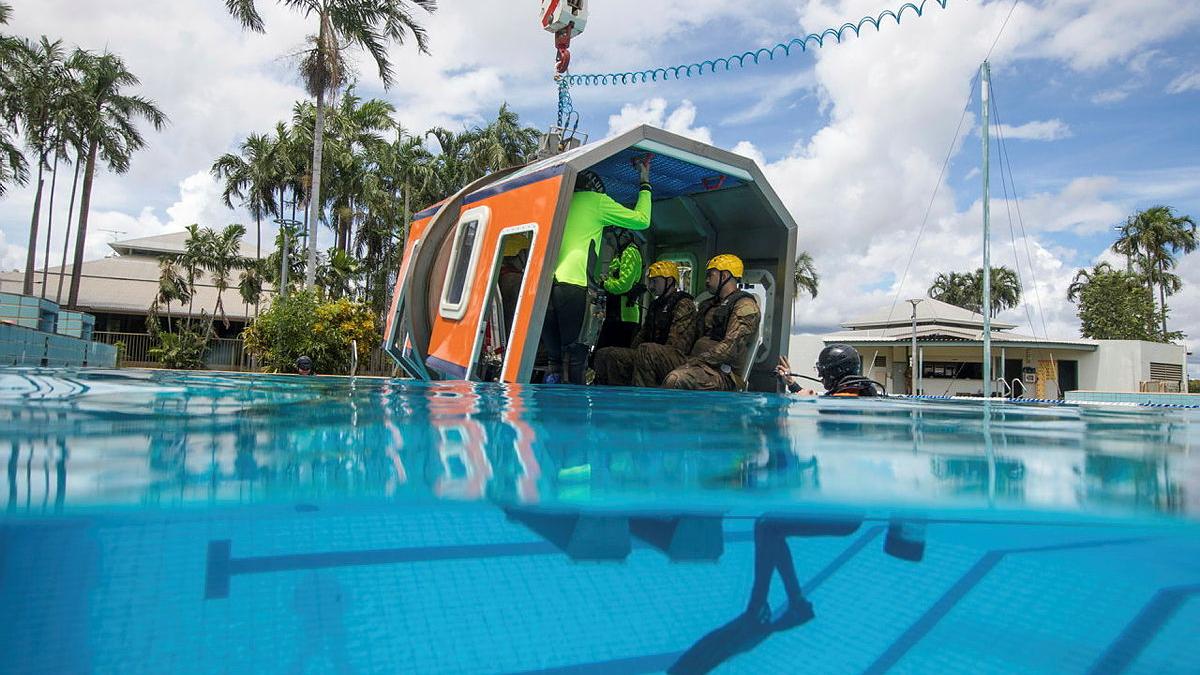
With soldiers strapped into the seat of the helo dunker, the machine starts to rise up from the water.
Slowly rotating until their faces are parallel with the water, they begin the descent.
As a physical and audible clunk is heard, the escape begins – seatbelts are unstrapped, the window is pushed out and one by one, each person exits and breaks the water’s surface.
Each trainee must go through this exercise six times, the last three with a blindfold.
Helicopter underwater escape training (HUET) is conducted to ensure soldiers understand how to escape from a submerged helicopter.
Personnel from across 1 Bde recently tested their ability to stay calm under pressure during the training at the Robertson Barracks pool.
For many of the soldiers, the challenge was physically and mentally demanding.
'They’ve proven they can keep a cool head in an unpleasant situation, which means I can trust them more.'
Cpl Michael Currie said as a long-time swimmer, he found the activity tough as he also photographed the day.
“You have to learn to relax, trust the drills and work through each sequence,” Cpl Currie said.
“Once the simulator goes under, it becomes very clear why the training matters.
“It was also a good opportunity to test out some underwater photography.”
The serials forced soldiers to rely on touch, rehearsed drills and controlled breathing.
OC ACoy 5/7RAR, Major Nicholas Alexandrou, said the training gave soldiers practical skills that could be used in high-risk environments.
“HUET is a low risk activity which gives us a taste of fear – the discomfort is essential,” Maj Alexandrou said.

“It’s done in a tightly controlled environment with supervision, so if there’s the slightest chance of injury they will intervene.
“Learning these skills in a safe environment means we won’t be forced to learn from scratch in a real-life situation."
Maj Alexandrou said the training also helped build confidence in soldiers who may need to move by air or water during future activities.
“They’ve proven they can keep a cool head in an unpleasant situation, which means I can trust them more,” Maj Alexandrou said.
“In this job, we must trust the soldier next to us will do their duty, no matter what the circumstances.”
After completing the escape drills, soldiers moved into sea survival training, where they learnt how to operate life rafts and use survival equipment after exiting an aircraft or vessel in the water.
“You leave with more confidence than when you started,” Cpl Currie said.
Related stories


