Providing dental care in a combat zone
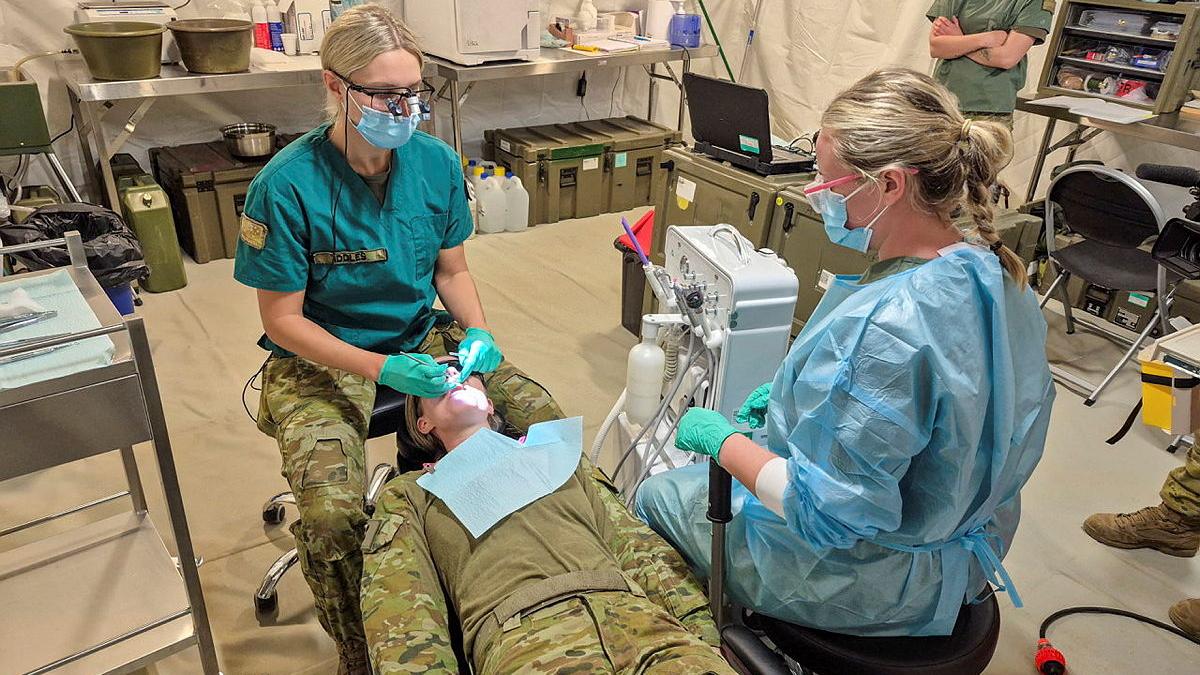
Learning to work under pressure in combat dress and body armour, treating emergency dental trauma cases in tactical scenarios and coping with simulated mass-casualty events may not be the daily experience of most Australian dentists.
But for Capt Tiarnee Iddles, of Darwin-based 1 Health Bn, part of 2 Bde, it’s simply part of the job.
A major activity such as Exercise Pozieres Run – the 1 Div annual warfighter event – held at the Shoalwater Bay Training Area and across central and northern Queensland – can throw up a multitude of challenging situations for Army dental personnel.
“Exercise patients could potentially be MASCAS or dental simulation cases,” Capt Iddles said.
“For mass casualty scenarios, we could be part of the wider hospital team potentially helping out by moving patients or even providing some medications as a dental officer. Dental assistants generally will help out with moving patients to various areas as well.”
But Army dentists also need to be just as competent at everyday procedures as their civilian counterparts.
“We can see everything that you'd see in a normal dental clinic. We’ve been doing a few dental checks and cleans, and then we've had one patient with a little bit of dental pain. So pretty much anything you can do in a normal clinic we can do here,” Capt Iddles said.
That said, real-world dentistry in a military context can present unique challenges that the average dentist would be unlikely to face.
'We can see everything that you'd see in a normal dental clinic. … So pretty much anything you can do in a normal clinic we can do here.'
“The patients we see are typically dental trauma cases. For example, a rifle to the face might potentially cause the tooth to be knocked out, so that's why we pack a lot of oral surgery kits and trauma kits, and also provide education to medical officers and other health professionals so they're able to manage those types of cases,” she said.
Army dental staff also have access to state-of-the-art capabilities the average civilian dentist could only dream of. Chief among these is the Smart-Port dental system, an ultra-portable all-in-one surgery in a box containing two dental drills, suction and an ultrasonic tooth cleaner.
Far smaller and lighter than its predecessor, it allows 2 Bde’s dental teams to deploy more swiftly where they’re needed and to be fully operational within a fraction of the time previously required.
For Capt Iddles, the other key difference is the sense of teamwork and camaraderie that is such a fundamental part of service life. She said it guides everything military members do.
“Being able to work as a wider health team within the hospital set-up is definitely something you wouldn't normally do in a civilian practice, and being able to manage dental trauma and dental emergencies a lot quicker and better than you might do in a civilian practice as well,” she said.
“What I find most rewarding in Defence is being able to give back to local communities. For example, up in Darwin we're able to do work with our NORFORCE soldiers, making them dentally ready. They can come to us with a wide variety of complex dental conditions.
“During placements with NT Health, we also go to remote communities. For example, I'm going to Alice Springs after this and providing a dental capability within that community.”
Related stories


