Making life-and-death decisions near the battlefield
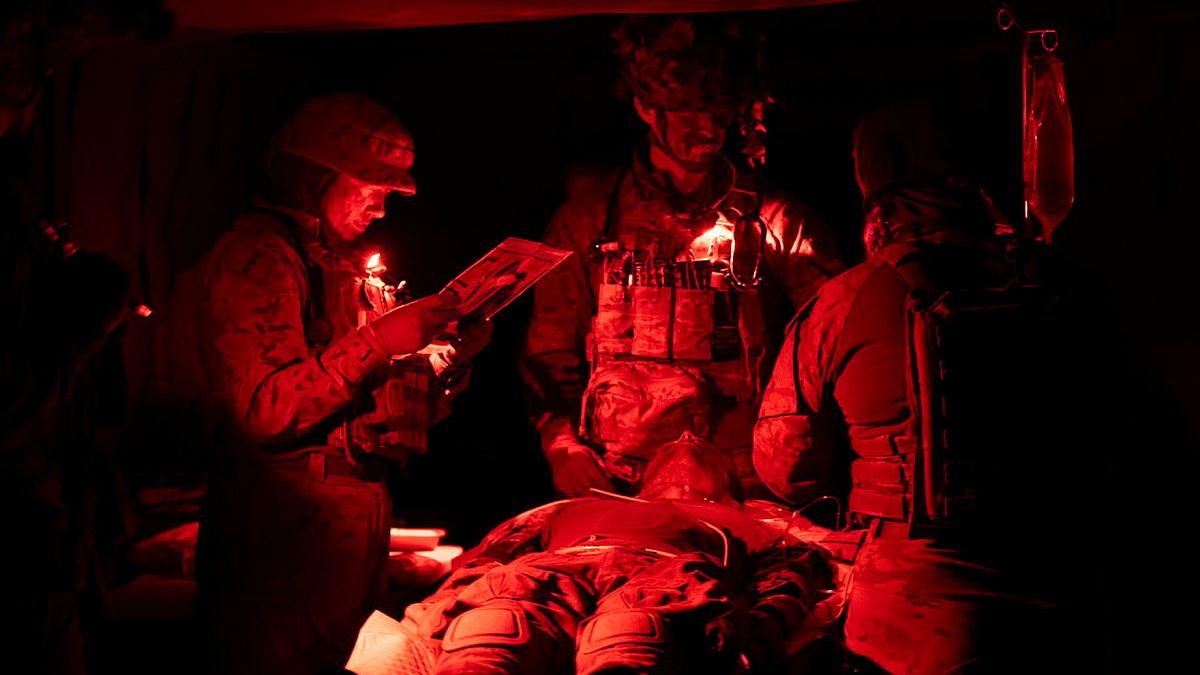
Working by the dim red light of a head torch and in almost total silence, an Army doctor moves purposefully along a line of badly ‘wounded’ soldiers laid out on the floor of a rocky forest clearing.
It’s the middle of a pitch-black, moonless night, with the front line perhaps only a kilometre or two away.
Injured just minutes earlier in vicious house-to-house fighting, each casualty is assessed for the severity – and survivability – of their wounds, and given a triage card bearing a designation from Priority 1 to Priority 4.
Priority 1 casualties – the most critical – require immediate, lifesaving treatment and evacuation. Priorities 2 and 3, while still seriously wounded, can survive for longer before they’re treated.
Priority 4 casualties are designated 'expectant', meaning their injuries are so grave they’re judged unlikely to survive given the resources available, and, as such, have the lowest evacuation priority.
This was the scenario members of the 2 Health Bn – part of 2 Health Bde – found themselves in on Exercise Pozières Run, which also acted as the 1 Div annual Warfighter event, held at the Shoalwater Bay Training Area and other locations across central and north Queensland.
Lt-Col James Savage, 2 Health Bn’s senior medical officer who oversaw the casualty collection point, said it was probably the most important decision-making process in a mass casualty event because it dictated the speed at which a patient received treatment.
“There are particularly difficult decisions with those we consider an expectant category, where we don't think they’ll survive the transfer to another medical facility,” Lt-Col Savage said.
“They’re given comfort measures, and they’re still treated, but they would not be on the first evacuation platforms out, because there are more survivable injuries in other casualties that we need to get out first.”
'We're very far forward – a couple of kilometres from where we believe the enemy would be – so there's a direct threat in this location. We’re also aware that we're quite a high-value target for the enemy.'
While this might be a straightforward medical decision, the psychological implications for the person making it can be difficult.
“The decision that treatment will, in essence, be futile is probably quite simple on the one hand, based on their injury pattern, but morally and internally, it’s more challenging,” Lt-Col Savage said.
While Priority 1 or 2 casualties may be sent to a Role 2 treatment facility – which can provide a range of basic lifesaving surgeries – the significantly closer Role 1 treatment team can use its more limited resources to stabilise casualties with life-threatening injuries, so they’re able to survive evacuation to a Role 2 facility.
The Role 1 can also provide treatment for more lightly wounded Priority 3 patients and return them to the fight.
Capt Harry Hayes, the doctor leading the Role 1 facility on the exercise, said once casualties had been moved to the Role 1 facility, the treatment team – usually comprising a doctor, nurse and three medics – made a series of critical decisions regarding their care.
“An example could be a patient that has a blast or a burns injury that comes to our location,” Capt Hayes said.
“We then stabilise them for rearward evacuation later on.
“Another example would be if a tourniquet has been applied to the limb to stop a major haemorrhage at the battlefront. The distance between us and the Role 2 Bravo might necessitate a tourniquet let-down procedure before they're able to be transported rearwards, which could be a life-saving or limb-saving intervention.”

While parts of the process would be familiar to an emergency team in a civilian hospital, the proximity of an enemy that may deliberately target a Role 1 facility adds another layer of jeopardy.
“We're very far forward – a couple of kilometres from where we believe the enemy would be – so there's a direct threat in this location. We’re also aware that we're quite a high-value target for the enemy,” Capt Hayes said.
“It changes things because we need to adapt to what our security environment is, what our notice to move is, how we're going to react to enemy fires or indirect fires.
“We're very conscious of our light emissions, our sound emissions and the protective measures we need to have around us.”
The need to be mobile and have a light, flexible footprint brings unique challenges, such as maintaining a sterile environment required for lifesaving procedures.
“Being on a medical team for an exercise where we come out here and we can actually provide medical care to the soldiers and provide them with the assurance that they're going to be looked after in an exercise environment is extremely satisfying,” Capt Hayes said.
Lt-Col Savage said demanding exercises like this could make the difference if Australia goes to war.
“This is why we join the Army and we don't remain in the civilian sector. We come here to practise clinical skills, but in a combat environment,” Lt-Col Savage said.
“You have to be careful what you wish for. We don't want to do this for real, but this is the best type of training opportunity we have to practise these skillsets.”
Related stories


