Four paws on duty
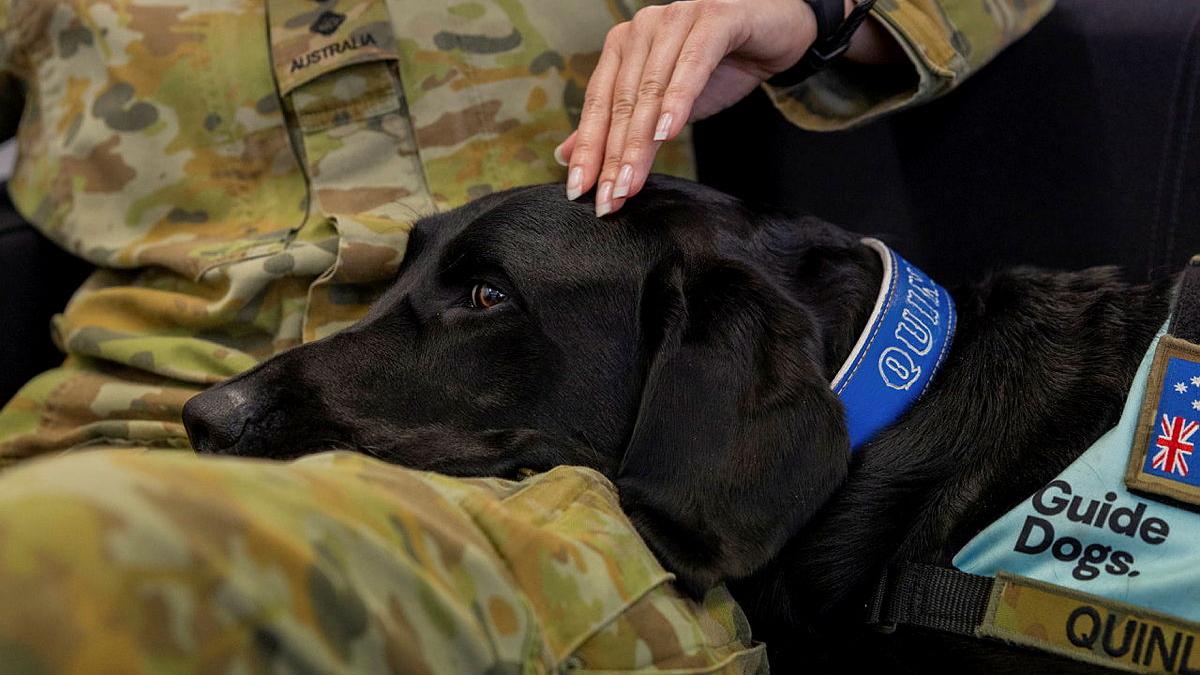
In a unit known for guns and grit, one of the most recognisable faces around is a black labrador named Quinley, who is housed by FSGT Darren Monopoli.
Supporting Quinley is part of a 12-month Defence trial supporting chaplaincy and welfare engagement across JMPU and the 1st Regiment, Royal Australian Artillery (1 Regt, RAA) in Brisbane.
Quinley began life in the Guide Dogs Queensland program and is among the 40-50 per cent of dogs that are redirected into alternative work.
Now nearly three years old, and still owned by Guide Dogs Queensland, Quinley quietly moves alongside 1 Regt, RAA CHAP Joanna Colgan as she goes about her day.
“The point of a facility dog is that people relax,” CHAP Colgan said.
“They sit down, start patting him and before long, they’re talking without really thinking about it. He takes the edge off straight away.”
'Quinley is a success story. He is emotionally aware. He reads people and he responds to the environment he is in. While those traits may not suit guide dog work, they are exactly what is needed in a wellbeing role.'
That is where Quinley spends most of his time; not in formal offices, but in the in-between moments of unit life, welfare conversations, informal check-ins and quiet conversations.
CHAP Colgan said the change in environment was immediate.
“People open up more. They talk more and if I walk through the unit without him, I’m asked straight away where he is. They notice,” she said.
The trial is part of a broader partnership between Defence and Guide Dogs Queensland, exploring alternative pathways for dogs that may not become guide dogs, but still have strong capabilities suited to other working roles.
For Guide Dogs Queensland dog supply and training manager Carolyn Rose, Quinley represents exactly what the program aims to achieve.
“We have to be honest when a dog isn’t right for guide dog work,” Ms Rose said.
“But that does not mean the end of their working life.
“Quinley is a success story. He is emotionally aware. He reads people and he responds to the environment he is in. While those traits may not suit guide dog work, they are exactly what is needed in a wellbeing role.”
She said the outcome was based on early training.
“The puppy-raising program exposes them to everything – people, places, noise and movement. That is what makes them adaptable. Labradors in particular are very people-focused and they tend to stay that way,” Ms Rose said.
FSGT Monopoli said Quinley adapted to Defence life quickly.
“From the start, he just fit,” he said.
“He has been really effective with our social worker and welfare teams. You can see people settle quicker and conversations start easier. He changes the tone of the room.”

Related stories


