Wiring up training innovation
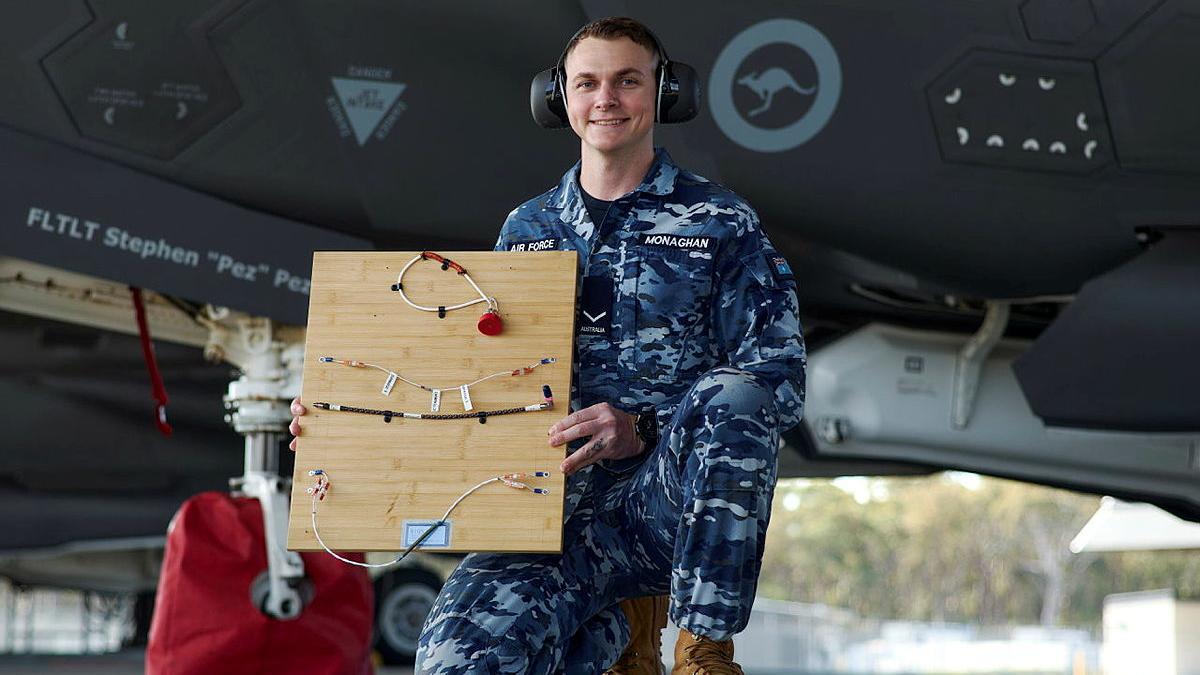
When LAC Zachary Monaghan identified a growing problem facing junior avionics technicians – fewer opportunities to practise fundamental wire repair techniques during day-to-day maintenance – he set out to solve it.
“I recognised a growing training gap and developed a wire repair board to give junior technicians a practical way to build confidence and competency before carrying out repairs on aircraft,” LAC Monaghan said.
Many junior technicians had limited exposure to basic wire repairs and little experience with the NAVAIR Wire Repair Manual, the primary reference for avionics wire repair procedures. As the F-35A Lighting II requires less traditional wire repair work, opportunities for technicians to learn these skills through real-world maintenance have become increasingly rare.
“In the past, technicians tended to learn on the job as faults were discovered, but I saw an opportunity to create a more structured and repeatable training experience,” LAC Monaghan said.
Using readily available materials sourced through existing logistics channels, and with the support of the Williamtown EDGY Lab, LAC Monaghan built a dedicated wire repair training board for about $70. The board enables technicians to practice a range of repair techniques, including stripping insulation, joining conductors and completing wire repairs in accordance with the NAVAIR manual.
'The board gives junior technicians more time to develop their skills and confidence before performing repairs on an aircraft.'

“Rather than reading about repairs in a publication or waiting for a suitable maintenance task, trainees can now get hands-on experience early in their careers,” he said.
The training aid has already delivered encouraging results, with several personnel using the board to sharpen their skills and build confidence.
“The board gives junior technicians more time to develop their skills and confidence before performing repairs on an aircraft,” LAC Monaghan said.
“What we’ve seen is that technicians have become much more comfortable navigating the repair manual and applying the correct techniques.”
The innovation has also gained strong support from squadron leadership. Plans are now underway to integrate the activity into fitter progression training, particularly for technicians who have recently completed their type course.
While the board is currently used within 3SQN, LAC Monaghan is continuing to refine the training aid and gather feedback to further improve the experience and explore opportunities for broader adoption.

Related stories


