Ghost Bat is revealed in colour
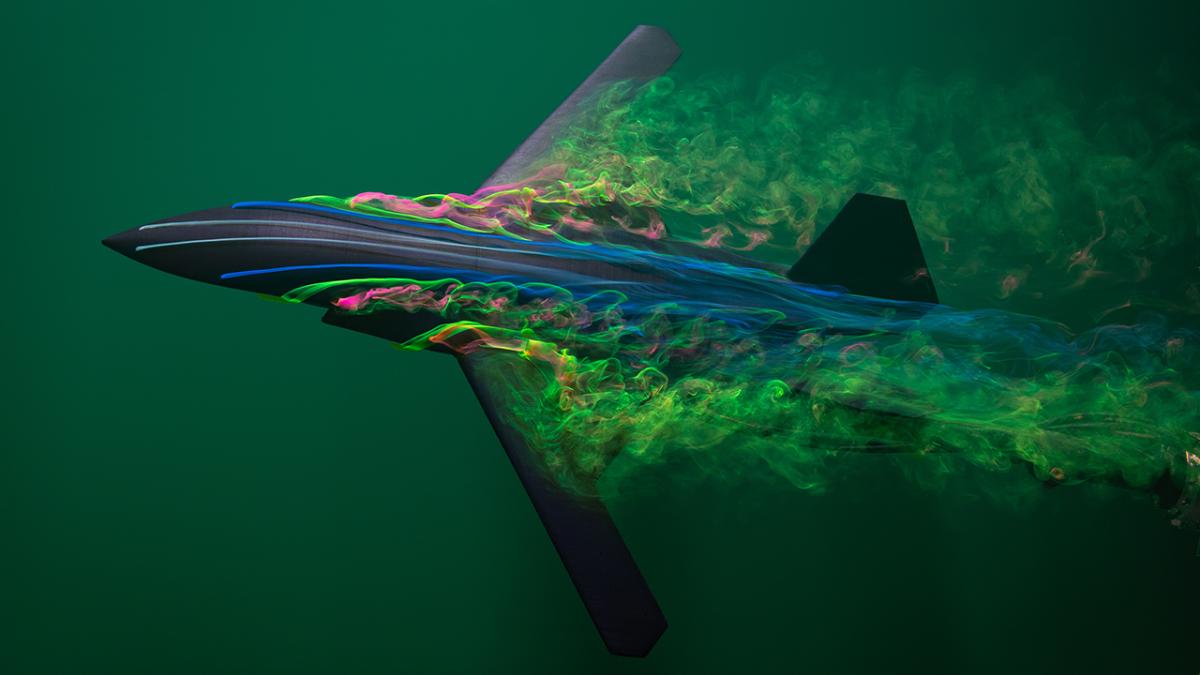
Swirling fluorescent dyes and vivid colours help Defence Science and Technology Group (DSTG) scientists uncover the aerodynamics of the latest MQ-28 Ghost Bat design.
By observing coloured dyes flowing around a submerged model in DSTG’s newly refurbished water tunnel in Melbourne, scientists map complex flow patterns and analyse aerodynamic performance.
The striking coloured imagery highlights the water tunnel’s unique ability to visualise how the Ghost Bat moves, a phenomenon which otherwise would have been invisible. The experiments provided fast, preliminary indications of the flow characteristics around the new design.
Beyond supporting the Ghost Bat program, the tests now also help DSTG scientists enhance their understanding of flow visualisation techniques and improve the analysis of future models tested in the water tunnel.
Since completing an aerospace engineering degree supported by a Defence STEM cadetship, Connor Marshall has worked with DSTG as a wind-and-water-tunnel test engineer. He leads experimental test campaigns, including developing physical models of Defence platforms to support aerodynamic analysis.
“This was the first test following that retrofit to prove that it was ready and functional,” Mr Marshall said.
“It demonstrated that the water tunnel is great for low-cost testing.
“In the future, we could set up and run tests like this within a week or two, which complements longer and more complex wind-tunnel testing.”

Graduate student Ryan Zeplin worked with Mr Marshall on the week-long test campaign. They designed and 3D-printed a sub-scale model of the Ghost Bat specifically for water-tunnel testing, incorporating tubing to allow five dye colours to flow from the front of the model.
The primary purpose of the testing was to identify flow features for closer investigation in more precise tests to be carried out in DSTG’s low speed wind tunnel.
In parallel with the physical flow visualisation, another team of Defence scientists undertook an extensive computational fluid dynamics modelling effort.
The eye-catching observations from the water-tunnel testing were in line with the results predicted by the computer modelling.
According to Mr Marshall, the real success story was seeing experts combining the benefits of their different analytical techniques to improve understanding of the Ghost Bat’s aerodynamic properties.
“It was a great demonstration of our national sovereign capability,” he said.
“We enjoy seeing our aerodynamics research contribute to future Defence capabilities.”
DSTG’s expertise in computational and experimental aerodynamics has contributed to the Ghost Bat program since its inception.
Wind-tunnel facilities provided critical aerodynamic data to support the initial design optimisation and DSTG high-performance computing has delivered continuous input through spiral upgrades to the Ghost Bat platform.
Related stories


