A fighter that outlived its era
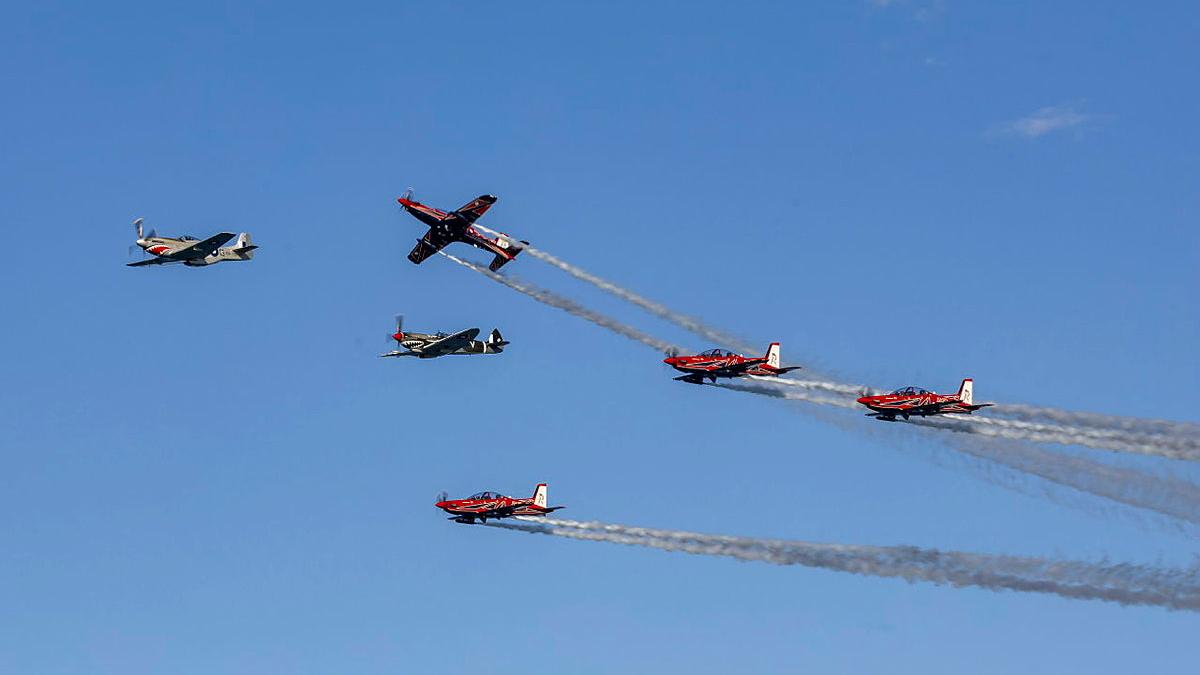
For three days above the Gold Coast, one aircraft carried more than the sound of a Rolls‑Royce Merlin engine – it carried history.
At the Pacific Airshow, 100SQN’s CAC CA‑18 Mustang flew alongside the Air Force Roulettes’ Pilatus PC‑21s and two Spitfires, bringing together a World War II‑era fighter and the aircraft now used to train Australia’s next generation of pilots.
But for 100SQN aircrew, the formation was more than a display. It was a moment to honour an aircraft that has never stopped serving.
SQNLDR Samuel Da Graca Costa said the Mustang’s longevity is part of what makes it extraordinary.
“It is one of the longest‑serving Mustangs still in military ownership since it was delivered in the late 1940s,” SQNLDR Da Graca Costa said.
“It’s an incredible design, well ahead of its time.”
Originally built for long‑range escort missions, the Mustang went on to prove its worth again in the Korean War. For 77SQN crews serving with the British Commonwealth Occupation Forces in Japan, the conflict arrived without warning. Their long‑awaited return home was cancelled overnight when North Korean forces invaded South Korea.
“They had a farewell party the night before,” he said.
“They woke up expecting to go home and were told, ‘No – you’re off to Korea’. The aircraft transitioned straight into offensive and defensive operations.”
Today, the Mustang’s role is different, but no less meaningful.
“One of our biggest priorities is preserving these aeroplanes,” SQNLDR Da Graca Costa said.
“We treat them with enormous respect. Every change in power, every movement, is about protecting those engines.”
'It is one of the longest‑serving Mustangs still in military ownership since it was delivered in the late 1940s.'

Despite its age, the Mustang still holds its own in formation flying.
Roulette 5 pilot FLTLT David Burnard said flying beside the heritage aircraft was a career highlight.
“The planes are absolutely beautiful in the air,” FLTLT Burnard said.
“You can actually hear them through the side of the canopy of the PC‑21.”
For 100SQN CO WGCDR Richard Brougham, the formation showcased how far Air Force training has come.
“We’ve had a unique opportunity this weekend to show how good the current training system is,” WGCDR Brougham said.
“We can put someone straight into an aircraft with the same performance as a WWII fighter, with very minimal aviation background. That’s a testament to the evolution of technology, simulation and our training staff.”
But above all, the Mustang’s presence at the airshow was about connection – between eras, aviators and the public.
“There’s a great opportunity to engage with people about what we do, what their Air Force has done and, hopefully, inspire future generations,” WGCDR Brougham said.
On the beach below, that inspiration was already visible.
“It’s so cool to see the next generation of aviators come out and say hello,” FLTLT Burnard said.
“Sharing our passion with them is one of the best parts of the job.”
Above the Gold Coast, the Mustang, Spitfire and PC‑21 offered a glimpse of how Australian military aviation has evolved – while proving that some things never change. The passion for flying endures. And the Mustang, still serving after 75 years, continues to tell its story.

Related stories


