Two nations go head to head in cyber battle
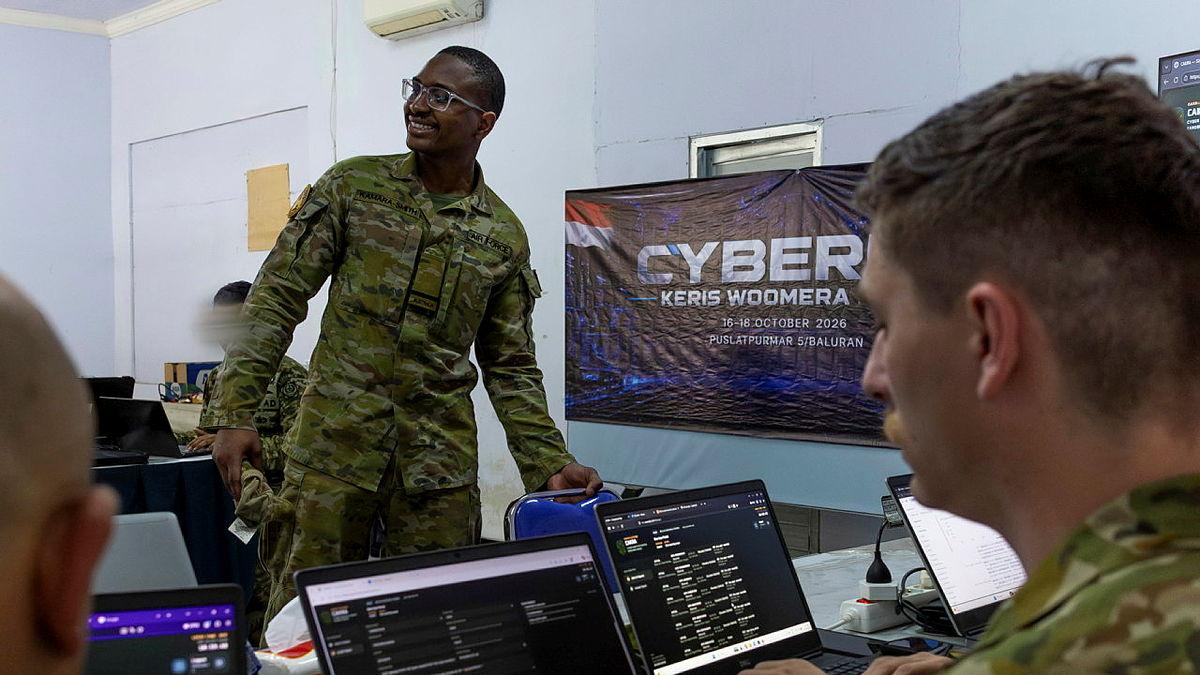
Integrasi. In Bahasa Indonesian, the word describes the blending of different elements into one complete, unified whole – this became the driving idea on the training grounds of East Java during Exercise Keris Woomera 26.
On October 16, ADF and Indonesian National Armed Forces (TNI) personnel came together at Pusat Latihan Tempur Marinir 5 Baluran (PLP-5) for a series of integrated field training activities.
Held after the amphibious beach landing, and ahead of the live-fire component, the training shifted the focus from bringing forces ashore to strengthening the skills and relationships across a range of specialist capabilities, including survival, geospatial technology, Role 2 health support and cyber operations.
The cyber training was a significant milestone for both the ADF and TNI, being the first time the two nations' militaries have conducted cyber training together.
The exercise involved teams running a ‘cyber battle’, testing each other’s ability to work effectively in an increasingly connected battlespace.
During the activity personnel took on opposing roles, with one team attempting to break into a simulated computer network while the other worked to detect the attacks.
FLGOFF Abib Kamara-Smith said the exercise was about identifying threats rather than stopping them.
“We have a team that is attempting to conduct an attack on the network, and another team actively identifying and triaging the indicator of compromise, while providing recommendations for ways to deter and defend,” FLGOFF Kamara-Smith said.
“So it is red trying to attack blue, and blue trying to identify the attack vectors.”
The ‘integrasi’ included each team learning how the other operated, recognising different approaches and finding practical ways to connect them.
But beyond the simulated attacks, the training was also an opportunity to share different techniques and learn to operate with unfamiliar technology.

FLGOFF Kamara-Smith said the TNI’s use of artificial intelligence offered a different approach to cyber operations.
“TNI use AI tooling to perform attacks at a rapid pace,” he said.
“ADF prefers a heavily manual methodology, prioritising deeply understanding the skill sets rather than immediately substituting with AI.
“Both TNI and ADF, however, understand the significance of AI in future cyber defence.”
For TNI cyber team member Second Lieutenant Ones Sitanggang, the exchange was just as valuable, with Australian personnel bringing systems and knowledge that his team had not previously encountered.
“Some Australians have different systems that we haven’t heard about before, and we have learned so many things from the Australians,” Second Lieutenant Sitanggang said.
“Also, the Australians have learned from us.”
He said the exercise was not about one nation outperforming the other, but about building capability together.
“There is no competition here, because although we are simulating a battle, we are working together,” Second Liuetenant Sitanggang said.
Integrasi across the multi-domain training enabled these distinct capabilities to contribute to a shared mission, bringing together different skills, technologies and ways of operating.
As the two forces prepare for the live-fire activity, the significance of integrasi matters most across different languages, specialisations, equipment, operating procedures and cultures.
The skills from the multi-domain training are central to Exercise Keris Woomera, held from October 12 to 20 and involving around 1000 ADF members and 1235 TNI personnel.
See more images and video of cyber training during Exercise Keris Woomera.
Related stories


