From mateship to mission
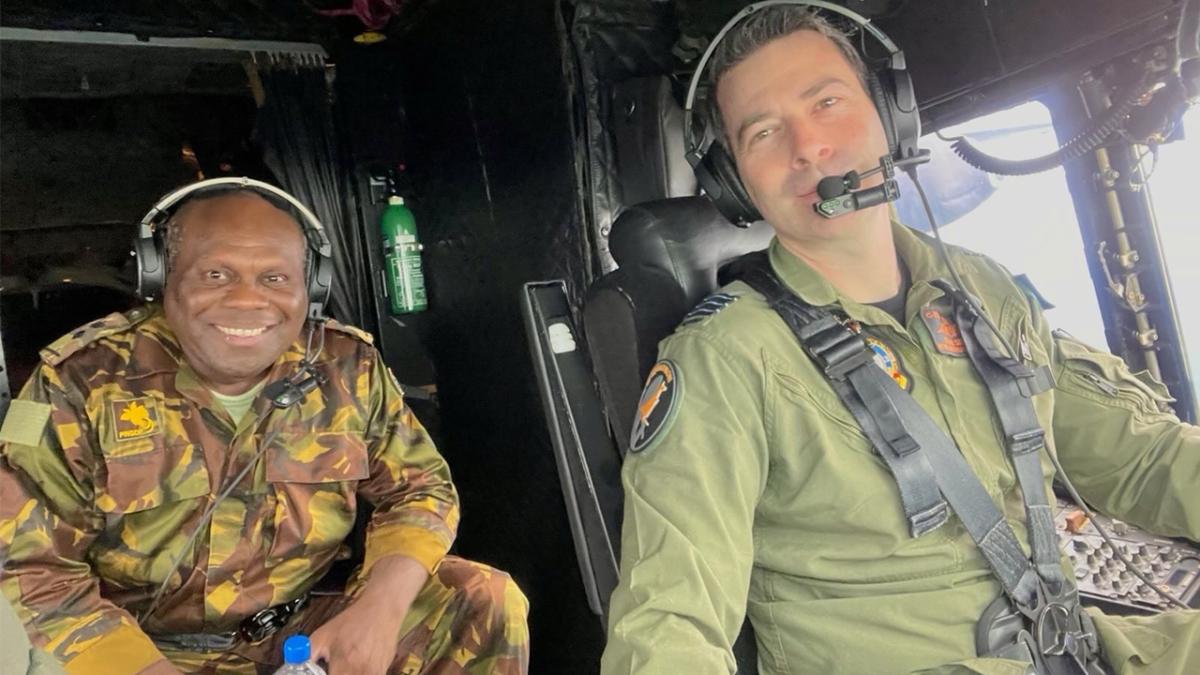
Over a meal in a Canberra pub, WGCDR Mark Seery and LTCOL Doug Vavar sketched out an idea that would take their air transport squadrons from a conversation to a remote airstrip at Green River, PNG.
They shared an ambition to build capability for their people and saw an opportunity to develop a validation exercise the two air elements could plan and deliver together.
Nearly three years later, the commanding officers of RAAF 35SQN and the Papua New Guinea Defence Force (PNGDF) Air Transport Wing (ATW), respectively, have watched that idea become reality through Exercise Kapa Pisin.
“We had a great time just chatting about our visions for what we wanted to achieve during our commands – for him 35SQN and for myself ATW,” LTCOL Vavar said.
“That's where the whole idea of Exercise Kapa Pisin came about – except, of course, we didn’t have a name for it back then. We talked about a validation exercise that we could work on together.”
That initial conversation grew into a genuine friendship. The commanders spoke by phone each month to exchange ideas, work through challenges and develop a roadmap for PNGDF ATW’s capability.
“We are probably the only two commanding officers that have regularly synced every month since 2024,” LTCOL Vavar said.
For WGCDR Seery, the scale of their progress became clear when the pair flew aboard a RAAF C-27J Spartan to survey the remote airfield at Green River, PNG.
“Being in Green River, it just sort of dawned on us that this could actually happen,” WGCDR Seery said.
“Something we had talked about a couple of years ago could become a reality.”

That vision has since been realised. WGCDR Seery credits much of the progress to his counterpart’s character, describing LTCOL Vavar as motivated, optimistic and energetic, with a passion that carries through to his unit.
“He really does care about his people. He cares about the country, cares about capability, but he’s also got that vision. He can see where it could go in the future,” WGCDR Seery said.
That vision has been complemented by WGCDR Seery’s restraint and willingness to let ATW develop on its own terms. LTCOL Vavar said he was grateful he had not visited 35SQN earlier in their friendship, when he might have been tempted to replicate its model.
“Had I seen 35SQN first, I would have gone away really excited to change my unit to look like 35SQN. Instead, ATW has grown organically to where it is, largely because of the relationship we've had,” LTCOL Vavar said.
The relationship now extends beyond the two commanders to their deputies, senior enlisted personnel and wider teams.
“Those that we answer to built the structure, but it's us who put the meat to the bones – and that’s through relationships,” LTCOL Vavar said.
“It’s not just us but it's all personnel. The integration between 35SQN and ATW is very unique.”
As both commanders prepare to hand over their appointments, they are working to connect their successors, ensuring the friendship between 35SQN and the ATW continues beyond their own tenures.
For WGCDR Seery, the susa skwadron (sister squadron) relationship will continue to evolve. For LTCOL Vavar, the priority is to build on the capability his team has developed and the confidence gained through working alongside Australia.
Exercise Kapa Pisin is just one milestone in that journey. More importantly, it demonstrates what the two forces can achieve when professional cooperation is underpinned by personal trust.
Related stories


