Sailor tops international targeting course
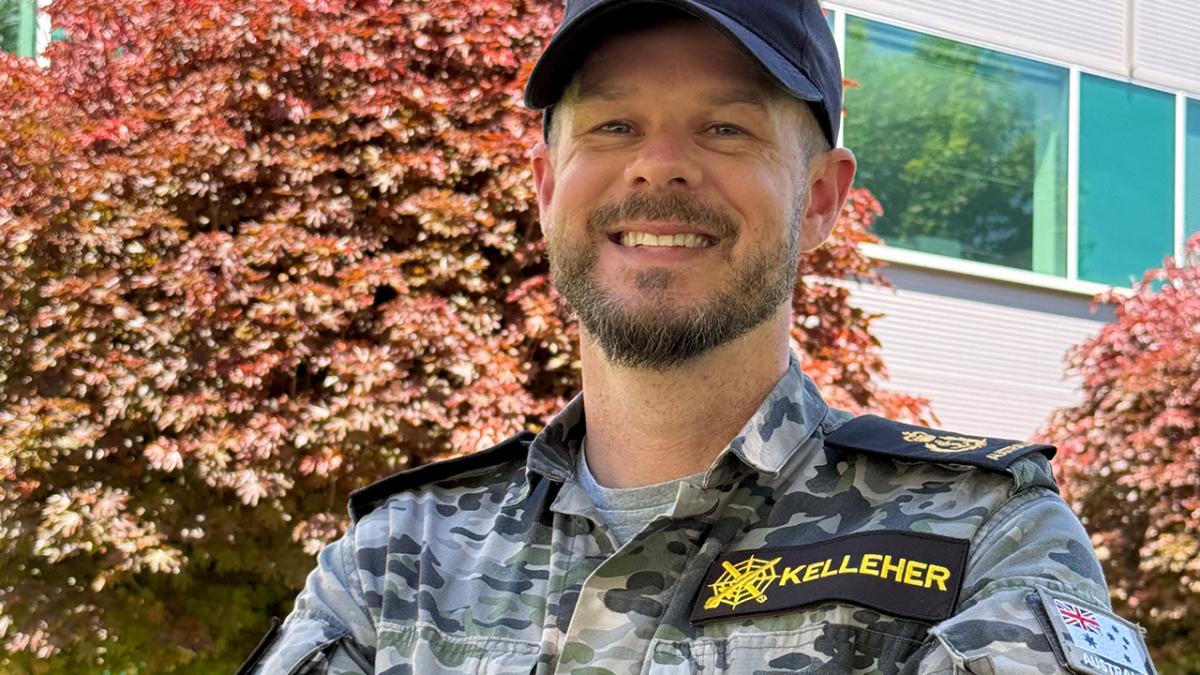
Just four months after he started targeting training, a RAN sailor has topped an international military course in Canada, earning student-of-merit honours against a cohort of experienced targeting specialists from the Canadian Armed Forces.
Wing Sergeant Major of the Defence School of Intelligence – Canberra's Targeting Wing, CPOCSM (Underwater) Daniel Kelleher, achieved the highest overall results on the three-week course, delivered by the Canadian Armed Forces Joint Targeting School.
For CPO Kelleher, the accomplishment marked an unexpected milestone after transitioning from an underwater warfare background into the specialised field of targeting.
"After spending a majority of my career seeking technical mastery as an underwater CSO at the tactical level, the opportunity to be the first in my category to contribute to operational targeting is an important and exciting challenge,” CPO Kelleher said.
“It’s been a steep learning curve in a very short time, but I’ve found that my previous experience as a CSO has helped me adapt and understand targeting processes quickly.”
The joint targeting course prepares military personnel for specialist targeting roles within operational headquarters where staff synchronise intelligence, operations and military effects to support a commander's objectives.
Personnel from Canada and allied nations attend the course to develop advanced targeting knowledge and planning skills. Just like specialist targeting staff courses delivered in the United Kingdom, Canada is accredited by the United States Joint Targeting School.
CPO Kelleher said targeting staff play a critical role in helping commanders make informed decisions during operations.
“Targeting staff work as a team to ensure the commander is able to meet operational objectives efficiently,” he said.

“That’s not just important to meeting the tasks asked of us strategically, but also for integrating our targeting processes and procedures with allies and partners."
Senior instructor of Canberra’s Targeting Wing, MAJ James Casey, said the result was particularly impressive given CPO Kelleher's limited experience.
"Several of CPO Kelleher's course mates had more than a decade's experience in effects coordination from across the Canadian Armed Forces,” MAJ Casey said.
“Having only recently been introduced to the subject, it's an incredible achievement and a testament to Navy's people."
MAJ Casey said specialist targeting skills would become increasingly important as Defence continued to develop its long-range strike and integrated force capabilities.
"Joint targeting involves specialised intelligence and operational staff working together through the joint targeting cycle. Their work ensures that the commander's plan, and the kinetic and non-kinetic effects being employed, are in lock-step," MAJ Casey said.
"At the operational or theatre level, it's vital in making the most efficient use of assets to enable the larger plan."
The Defence School of Intelligence – Canberra delivers joint, common and rationalised intelligence and targeting training to personnel from across Defence. The school has also seen growing interest from Navy members seeking to develop targeting expertise for operational headquarters and joint force roles.
MAJ Casey said it was encouraging to see a broad range of Navy specialisations, including information warfare, intelligence, and geospatial warfare officers and sailors getting more involved in Navy’s contribution to joint targeting.
'After spending a majority of my career seeking technical mastery as an underwater CSO at the tactical level, the opportunity to be the first in my category to contribute to operational targeting is an important and exciting challenge.'
“I can envisage a future for my own and other sailor categories to follow the same pathway, to help meet the unique challenges that Navy faces at sea," he said.
Director Navy Targeting and Fires, CAPT Adam Muckalt, RAN, said Navy is continuing to build a targeting enterprise that encompasses all aspects of operations in the maritime domain.
“Targeting is not new to Navy, but our modern weapon systems have increasingly complex data, intelligence and strike coordination requirements,” CAPT Muckalt said.
“They will require our members to undertake both common training – such as that offered at the Defence School of Intelligence – and effector-specific courses that draw upon the deep expertise already present within the Navy warfighting family.
“The recent creation of the geospatial and underwater warfare specialist categories, along with our existing Navy intelligence and above-water warfare sailors, will provide the backbone of Navy’s targeting workforce delivering enhanced lethality both below and above water.”
Operational and long-range fires and targeting are a priority under the Government's National Defence Strategy, with maritime capabilities such as Tomahawk, the Naval Strike Missile and Ghost Shark expected to enhance the ADF’s ability to hold adversary targets at risk at greater ranges.
CPO Kelleher said he intended to apply the knowledge gained on the course to develop Navy's contribution to Navy and joint targeting workforces.
"With a dedicated training facility opening in Canberra next year, the opportunities for current and future training are looking great," he said.
To find out more or to get involved with the Navy Targeting Enterprise, personnel are encouraged to speak with their divisional staff and/or career manager.
Related stories


