From forecasts to plaster casts
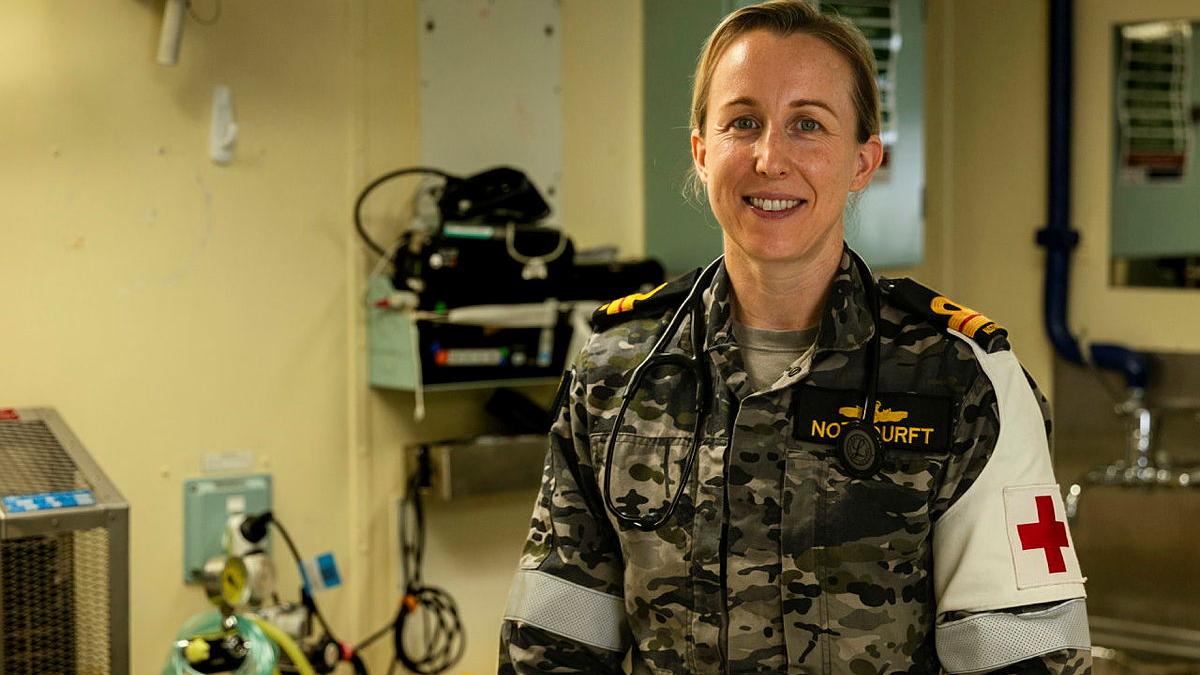
A decade ago, medical officer LEUT Kiri Nothdurft had perfected a familiar explanation about her role as a meteorology and oceanography officer (METOC).
“It’s meteorology. Yes, like the weather, not horoscopes,” she said.
The former METOC eventually traded weather forecasts for patient care, becoming a medical officer.
Today, the question she is most often asked is: “What’s it like to be a doctor at sea?”
Embarked in HMAS Perth, LEUT Nothdurft serves alongside POMED Tahnee Edwards and ABMED Bethany Scott.
Together, the team provides healthcare support to the ship’s personnel of about 200.
LEUT Nothdurft joined Navy as an officer of the watch in 2004, gaining her platform endorsement in HMA Ships Manoora and Ballarat.
She later served with the Bureau of Meteorology and HMAS Albatross, specialising in meteorology and oceanography before transitioning to medicine.
'I always felt health was a safe place for me, and I wanted to be the person sailors could turn to when things weren’t going to plan.'
After several years working in a joint headquarters environment in Canberra, she embarked on a seven-year journey of medical study and clinical training.
“Health is one of those things that can make or break someone’s experience in service,” LEUT Nothdurft said.
“I always felt health was a safe place for me, and I wanted to be the person sailors could turn to when things weren’t going to plan.”
The decision to leave an established career field was not one she took lightly.
“I wanted my next career to be equally meaningful. Medicine appealed to me because it allowed me to help people directly and make a difference face-to-face,” she said.
Her three years working as a civilian doctor before returning to Navy service provided valuable experience across a broad range of patients and clinical presentations.
At sea, the medical team’s responsibilities vary according to the ship’s activities and operational requirements.
Whether supporting routine training or responding to emergencies, they remain ready to act at a moment’s notice.
'What’s encouraging is that when a serious medical event occurs, it very quickly becomes a whole-of-ship response. We always feel well supported.'
“With medicine, you never know what’s going to walk, crawl or get dragged through the door, so we’re always prepared,” LEUT Nothdurft said.
“What’s encouraging is that when a serious medical event occurs, it very quickly becomes a whole-of-ship response. We always feel well supported.”
Her background as both a METOC officer and officer of the watch provides a unique understanding of the challenges faced by sailors at sea.
“I understand the operational context and many of the stresses our people experience while deployed,” she said.
After more than a decade ashore, LEUT Nothdurft has noticed some significant changes to Navy life.
“The food is better and connectivity has improved significantly with Wi-Fi and streaming services,” she said.
“But the fundamentals remain the same. Damage-control training, ship evolutions and teamwork are still at the heart of life at sea. We’re all in it together.”
Maintaining medical readiness remains a key priority throughout deployment.
“By working closely with medical teams from other RAN ships, and even a US Navy ship, we’ve been able to replenish essential medical supplies while at sea,” she said.
Related stories


