Topping up in the eye of the storm
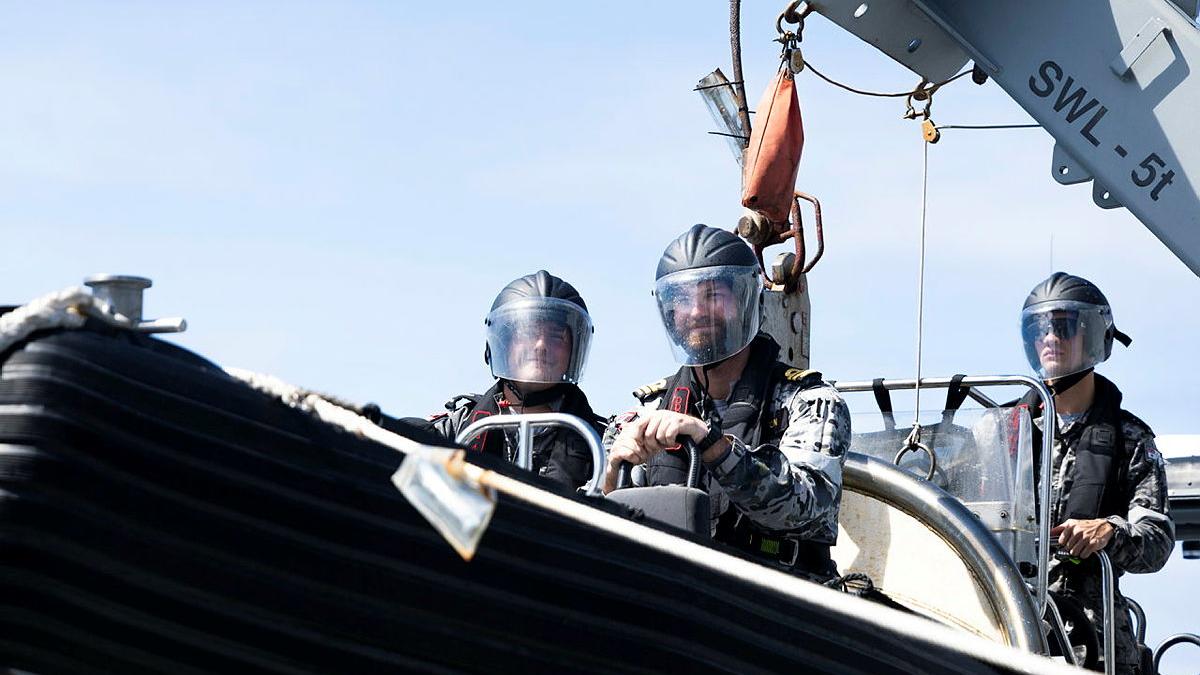
LEUT Nicholas Newton never expected to be in a Spanish warship coordinating refuelling at sea for seven ships as a hurricane approached.
But that’s exactly what happened when the HMAS Sydney surface warfare officer took on the role of operations officer for the US-led exercise staff on board ESPS Álvaro de Bazán during Exercise Pacific Dragon.
The task group had completed the main events of the integrated air and missile defence exercise, and participating ships were ready to depart for their onward destinations.
“The storm was blowing up, the weather reports were getting worse and the whole task group was conducting weather avoidance to remain clear,” LEUT Newton said.
“Everyone just wanted to sail away from the approaching storm, but they couldn’t because they all needed fuel first.
“There were a few stressful moments as we coordinated replenishment at sea for seven ships and directed them to safe areas, that’s for sure. But it was also really interesting problem solving and a great experience.”
The replenishment ship USNS Washington Chambers refuelled all seven ships before Hurricane Lala, packing winds of up to 121km/h, bore down.
LEUT Newton joined Álvaro de Bazán, the host ship to the USN Destroyer Squadron 31 command team, for Exercise Pacific Dragon.
“It was my first time working in the headquarters of a multinational exercise. The HQ comprised of Americans, a Chilean and two Australians,” LEUT Newton said.
“A highlight of the exercise was observing how quickly the multinational team found common language and came to the same page about how to execute what was a technical and comprehensive program to conduct missile defence across ships from seven countries.”
'Frame for frame it was the exact same ship as Sydney, but it was so interesting to see how differently the Spanish operated. Their whole day was completely different.'
LEUT Newton said it was impressive to watch and be part of a team – with many not knowing each other a week before the exercise – that came together and achieved mission outcomes.
“For me, professionally, it was a good experience. It was something I’ve never done before and, while it was hard, it was very rewarding as well,” he said.
“It’s good to do things outside my comfort zone and to be challenged.”
LEUT Newton said spending time on board one of Sydney’s sister ships was also a highlight of his deployment.
Álvaro de Bazán is the first vessel of the F100-class frigates, built by Navantia in Ferrol, Spain.
The class is the basis of the Australian Hobart-class destroyers, of which Sydney is the third ship to be commissioned into service.
“Frame for frame it was the exact same ship as Sydney, but it was so interesting to see how differently the Spanish operated. Their whole day was completely different,” LEUT Newton said.
“The Spanish crew were phenomenally good hosts and stoked to have us on board. They had a few barbecues on the flight deck and they’d get their band out and get us involved.
“They were all friendly, morale was super high and there was always someone to talk to at the end of each day.”
LEUT Newton also loved the traditional Spanish food and culture on board.
“It was an exciting experience for me – an opportunity I wasn’t prepared for when I was first given it, but one I’m very glad to have had the opportunity to do,” he said.

Related stories


