Cutting through the ocean noise
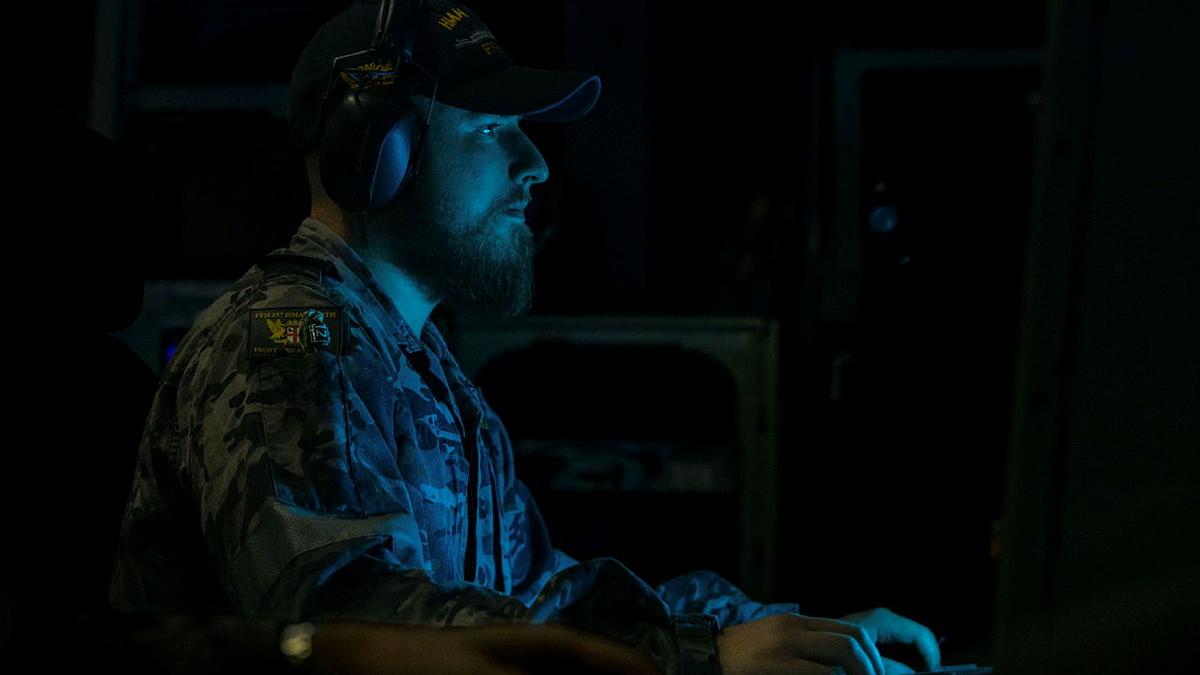
Deep in the heart of HMAS Perth lies a secret zone off-limits to most of the crew: the operations room.
Here, surrounded by screens and radios, a rotating team of warfare specialists work with intense concentration to keep all 190-odd crew members safe at sea.
Among the advanced technology and weaponry is the underwater sonar detection gear. It is a fitted sonar system manned at all hours of the day by watchkeepers.
A mix of colours on screen indicate different directions and frequencies. To the untrained eye, it is overwhelming. But to ABCSO Tristan Bryan, it’s his bread and butter.
“Put simply, it’s like throwing a tennis ball back and forth,” he said.
“When we change the settings the throw gets longer, quicker or shorter, giving us more of an idea of what’s ahead and around us.”
Training for the job of a CSO requires years of experience, starting with the basics of surface picture operations, radar and sonar theory, radio communications and general ship capabilities.
Then CSOs learn to interpret underwater sonar activity, including passive and active systems.
'If something’s there, it shows up in sound and on our screens, but it’s our job to be able to identify the different underwater elements that it could be.'
The specialised training means the operators understand their systems inside and out.
One of the unique parts of AB Bryan’s job is using headphones that allow him to hear underwater.
“It sounds similar to the normal white noise you get when you’re in a Navy ship, but there’s more gushing water, with a lot of static mixed in,” AB Bryan said.
“When there’s something that disrupts that white noise, that’s when it gets interesting.
“Around our area of operations, we’re always on the lookout for submarines and other contacts, but we’ve got to be careful as there’s sometimes marine life, such as snapping shrimp, whales and dolphins.
“If something’s there, it shows up in sound and on our screens, but it’s our job to be able to identify the different underwater elements that it could be.”
AB Bryan’s role is essential in building Perth’s tactical picture of what is under the surface during their Indo-Pacific regional presence deployment throughout South-East Asia.
During the deployment, Perth is working with international partners to undertake operations, exercises and other engagements to support long-term security and prosperity in the region.
Related stories


