Sea floor missions build understanding
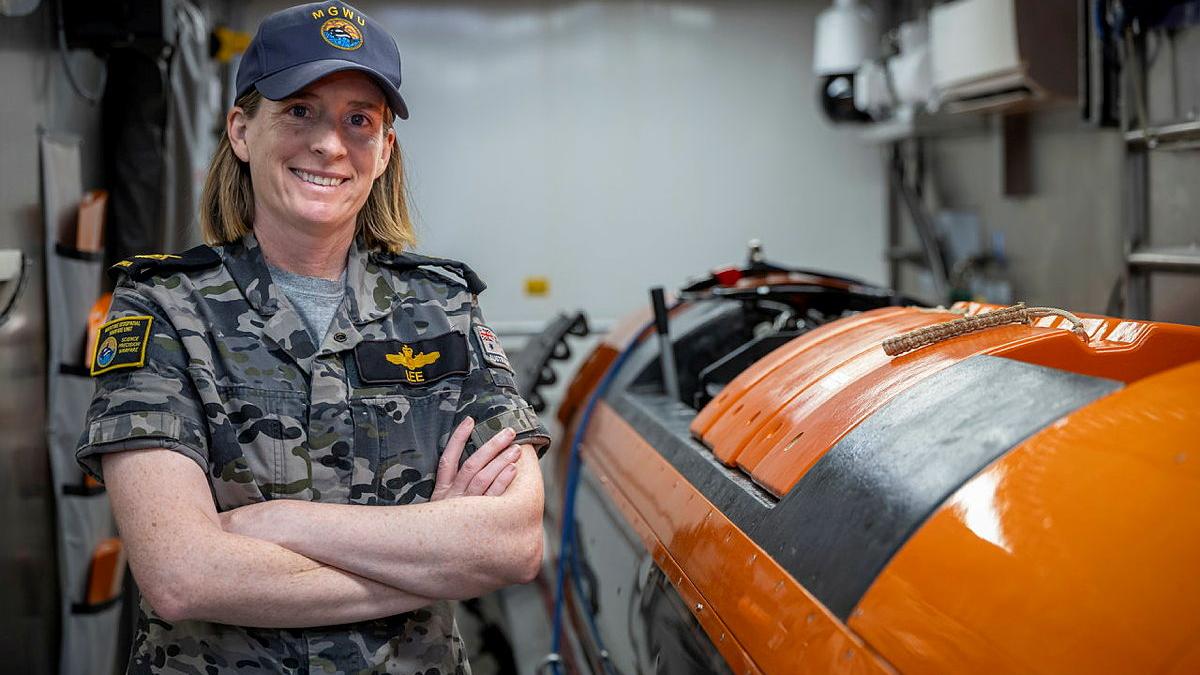
It was mission accomplished for Hydrographic Survey Manager CPO Hannah Lee, of RAN Deployable Deepwater Survey Team, during Exercise Rim of the Pacific (RIMPAC).
As mission data supervisor on board ADV Guidance, CPO Lee was a key player in the integration of the HUGIN Superior autonomous underwater vehicle (AUV) during combined experimentation activities with Australian and US personnel, under the AUKUS Pillar II banner.
The activity highlighted the integration of the HUGIN Superior AUV with a work-class remotely operated vehicle (ROV), providing an end-to-end capability to locate, identify and investigate objects on the sea floor.
The activity demonstrated advanced undersea warfare capabilities, integrating autonomous systems, deep-water robotics and underwater communications technology to strengthen allied interoperability in one of the world's most challenging operating environments.
Working alongside Defence Science and Technology Group (DSTG) and US defence scientists, the team conducted a series of trials focused on seabed surveying, underwater intervention and long-range acoustic communications, building on previous experimentation under AUKUS Pillar II’s Maritime Big Play.
While the AUV conducted wide-area seabed surveys and target detection, the ROV was used to inspect and manipulate objects at depths of up to 3000 metres using precision hydraulic manipulators, enabling operators to conduct detailed intervention tasks in the deep ocean.
CPO Lee said the activity highlighted the strength of collaboration between Australian and US personnel.
“Everyone came here prepared to achieve the mission, but also prepared to support one another wherever it was needed,” CPO Lee said.
“Once we were working together on board, Australians and Americans alike, the activity progressed smoothly and demonstrated the value of operating as a combined team.”
'Every time you send the AUV into an environment like that, you see something new.'
The team also supported the deployment and recovery of deep-sea moorings while conducting complex lifting operations in varying water depths.
CPO Lee said safety remained the highest priority throughout every evolution.
“The activities we conducted are inherently high risk because of the equipment, the water depths and the complexity of the operations,” she said.
“Every task was carefully planned and controlled, and everyone on board maintained a strong focus on safety. That professionalism allowed us to complete the activity safely and effectively.”
Beyond testing individual technologies, the experimentation validated the integration of Australian-developed underwater acoustic communications with US command-and-control systems, demonstrating the growing interoperability of allied undersea capabilities.
The activity also reinforced the unique role of the Deployable Deepwater Survey Team in supporting Navy's ability to operate in the deep ocean.
“Every time you send the AUV into an environment like that, you see something new,” CPO Lee said.
“It's an environment very few people have had the opportunity to explore, and every mission builds our understanding while strengthening our ability to operate alongside our partners.”

Related stories


