Service measured beyond medals
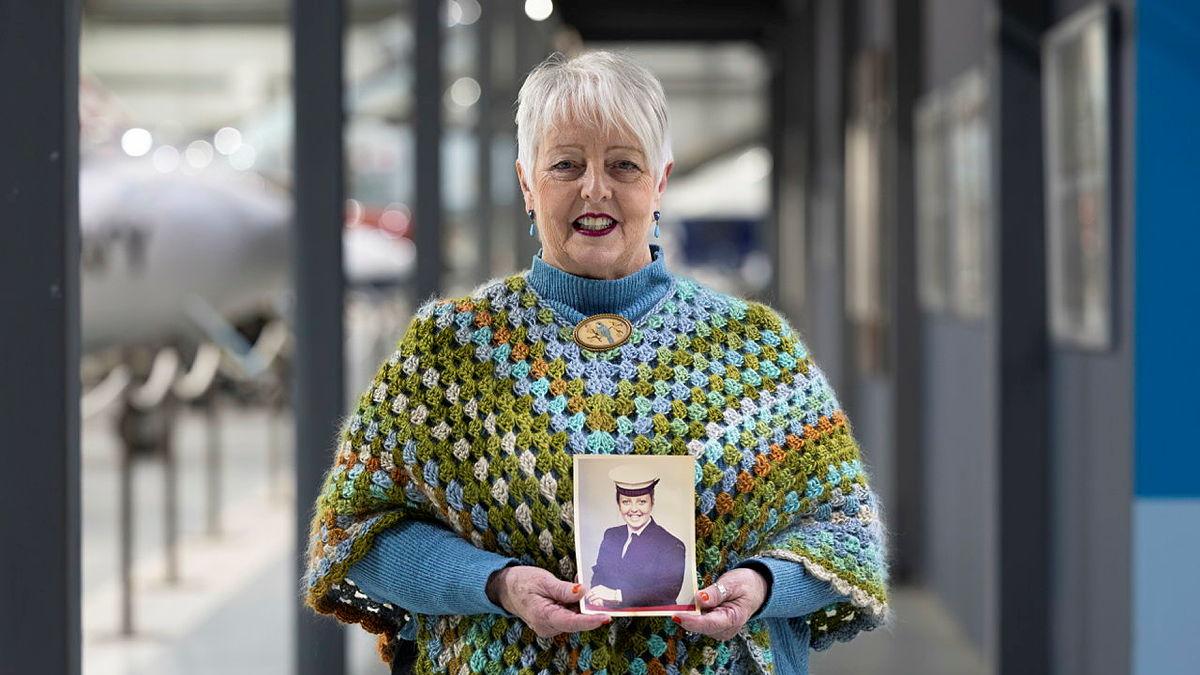
Sandi Foley De Vincenzo stood before guests at the Women in Navy exhibition at HMAS Albatross with a story that reached well beyond her own time in uniform.
Her speech was a profile in inherited service: a father who found family in the RAN, a mother who carried the weight of separation and hardship at home, and a daughter whose own Women’s Royal Australian Naval Service (WRANS) experience shaped a lifetime in health care and mentoring.
“It is both a privilege and a deeply personal honor to stand before you today as we celebrate the role of women in the Royal Australian Navy,” Mrs Foley De Vincenzo said.
For Mrs Foley De Vincenzo, Navy life began long before enlistment. Her father, known in the RAN as ‘Step Lively’, left Coventry, England, at 17 and came to Australia in search of a better life.
He soon joined the Navy and served for 22 years, including during World War II, the Korean War and the Vietnam War.
“For a young man who had never known his own father, the Navy became more than a career. It became family,” she said.
But the centre of Mrs Foley De Vincenzo’s speech was not only the uniformed service of her father, but the unrecorded service of her mother.
While her father was often away at sea for six or 12 months at a time, her mother endured years of separation and serious illness, including three open-heart surgeries.
One surgery followed shortly after Mrs Foley De Vincenzo was born, while her father was at sea and informed by telegram. Another left her mother paralysed down one side.
“She never wore a uniform. Yet she carried burdens every bit as heavy,” Mrs Foley De Vincenzo said.
It was a sharp reminder that the history of women in Navy cannot be limited to those formally enlisted. It also includes wives, mothers and families who sustained service from home, often without the formal support networks available today.
“Looking back now, I realise my mother was one of thousands of Navy wives whose contribution has largely gone unrecognised,” she said.
“Yet without women like her, many naval careers simply would not have been possible.”

Mrs Foley De Vincenzo eventually followed her own path into Navy, enlisting in 1976 as a dental nurse. She wanted to be a medic, but was placed in the second intake of WRANS dental assistants. The posting still felt natural.
“For me, like my father, it felt like coming home,” she said.
“We were proud to wear the uniform.”
Her service became the foundation for a long professional career in dental health, including work as a dental nurse, practice manager, educator, consultant and mentor to dental professionals across Australia.
She later spoke at Australian Medical Association and dental and medical conferences, and was nominated for Australian of the Year for her contribution to health care.
The values she carried forward were, she said, first nurtured through Navy: integrity, discipline, service and respect.
Those values today continue as service, courage, respect, integrity and excellence.
Her speech returned, finally, to a broader definition of service. Women in Navy history, she argued, included those who served in ships, aircraft, engineering, medicine, leadership and operations.
But they also included those who waited, raised children, supported partners and held homes together through long deployments.
“Service isn’t always measured by medals. Sometimes it is measured in sacrifice,” Mrs Foley De Vincenzo said.
Mrs Foley De Vincenzo’s story was not only about remembrance. It was about correcting the record.
“The history of women in the Navy is not only found in those who wore the uniform,” she said.
“It is also found in those who waited, who hoped, who raised families, who held homes together and who quietly carried the nation alongside those who served.”
See more images from the exhibition here.
Related stories


