Supply’s first contact with Philippine Navy
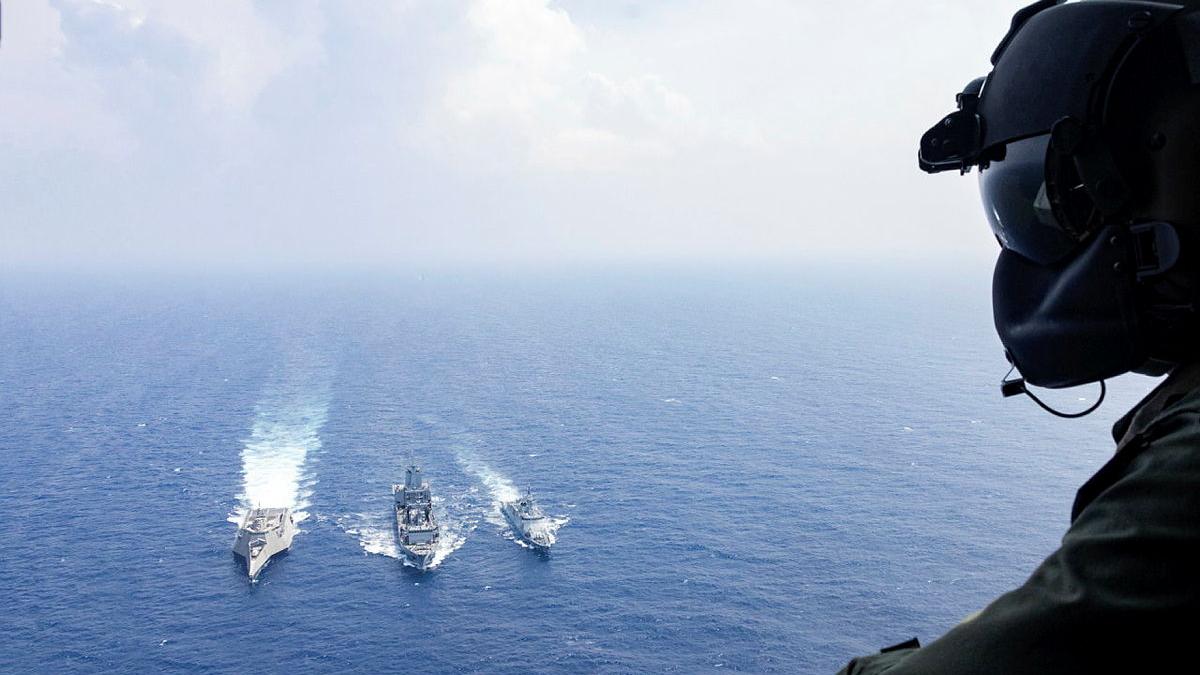
For the first time, HMAS Supply has conducted a replenishment at sea (RAS) serial with the Philippine Navy.
During a maritime cooperative activity (MCA) on August 25, Supply conducted a four-hour RAS in the South China Sea with Philippine Navy frigate BRP Diego Silang and US Navy’s USS Santa Barbara.
Sailing parallel, Supply and Diego Silang conducted a RAS-L (liquid) hook-up in order to practise transferring F76 marine diesel fuel.
This involved Supply extending a refuelling hose and probe along a span wire to the receiver ship, which connected to the probe via a bell mouth.
During the evolution, the ships maintained a separation out to about 54 metres while travelling together at about 12 knots.
The serial did not include the transfer of fuel or stores, and was conducted as a certification and proficiency activity.
The transfer of fuel and stores while underway can extend the range and endurance of receiver ships without the need to return to port, keeping them on station at sea for longer periods.
This RAS further builds the RAN’s ability to integrate with allies and partners throughout the region, while boosting the Philippine Navy’s own capability.

Australia and the Philippines have been working closely to enhance maritime interoperability, including through certifying Philippine Navy vessels to receive fuel and stores from RAN auxiliary oiler replenishment (AOR) ships.
In October 2022, frigate BRP Jose Rizal conducted a RAS-L with AOR ship HMAS Stalwart.
In February 2026, crewmembers from HMAS Toowoomba conducted workshops and training with Philippine Navy counterparts, with Toowoomba acting as a simulated AOR while it was approached by Diego Silang.
In addition to achieving unit certifications with the RAN, the Philippine Navy is also building RAS interoperability with other partners, having conducted similar activities with the US during Exercise RIMPAC and Canada during Exercise Balikatan.
Supply departed Australian waters in June for a regional presence deployment to the Indo-Pacific, and has worked in support of US Navy’s 7th Fleet vessels, including USS Santa Barbara.
CO Supply CMDR Kylie Turnbull said the MCA with the Philippines and US began with a shore phase in Subic Bay from August 19 to 20.
“Supply provided a mini-mobile training team of two experts in RAS seamanship and engineering to support and guide Diego Silang’s team through the evolution in order to prove their RAS capability,” CMDR Turnbull said.
Once at sea, the MCA included broader cooperation with the Philippine Coast Guard ship BRP Teresa Magbanua, as well as aircraft from the Philippine Air Force, US Navy and RAAF.

On August 25, the RAS serials began.
“BRP Diego Silang and USS Santa Barbara conducted RAS approaches on Supply to simulate dual RAS manoeuvring and station-keeping together before concluding the serial,” CMDR Turnbull said.
“We successfully achieved this thanks to robust RAS serial planning, excellent communications, expert ship handling and endless enthusiasm from all teams.
“All three participating nations demonstrated not only proficiency, but also a shared mental model, which translated to highly effective interoperability.
“Supply very much looks forward to our next opportunity to conduct replenishment with the Philippine Navy.”
Diego Silang is the second of a planned six Miguel Malvar-class guided missile frigates for the Philippine Navy, each displacing 3600 tons.
Commissioned into Philippine Navy service in December 2025, Diego Silang is named after 18th century Filipino revolutionary, and participated in the RAN’s 125 International Fleet Review and Exercise Kakadu off Sydney in late-March.
Supply is one of two Supply-class AORs in RAN service, and displaces 19,500 tons at full load.
Callsign ‘Orca’, Supply can carry 1450 cubic metres of JP5 jet fuel and 9000 cubic metres of marine diesel fuel, along with stores of fresh water, ammunition and other provisions.

Related stories


