Tactical precision on a grand scale
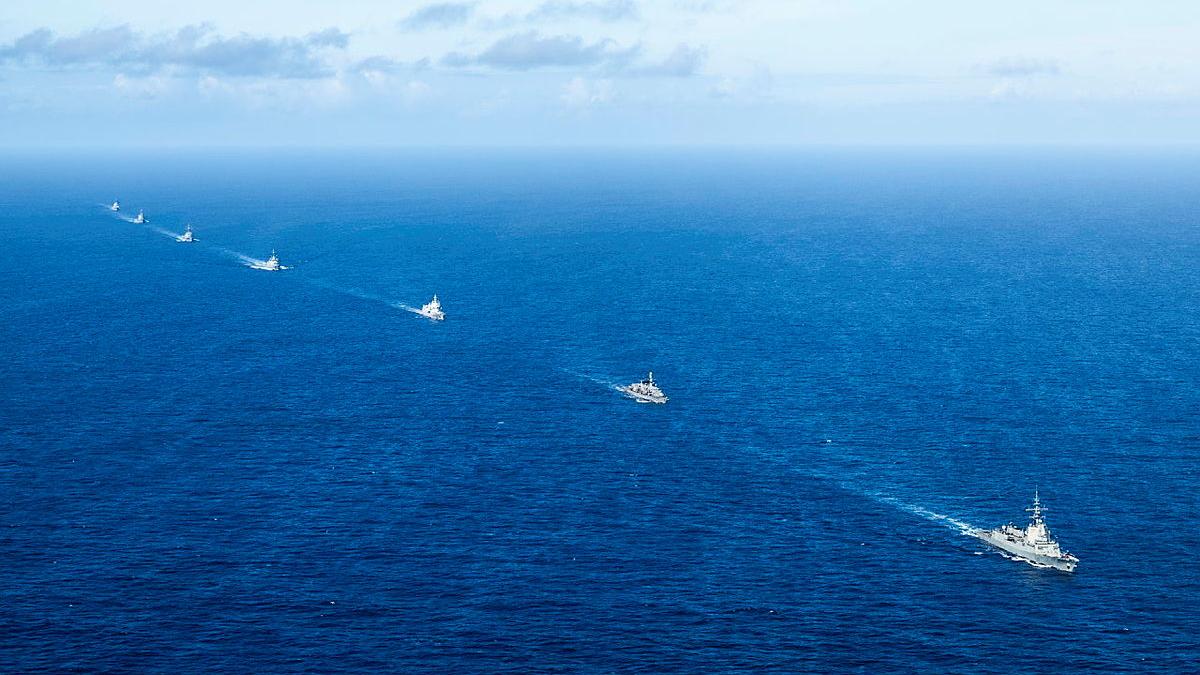
Ships from seven navies recently sailed in close company during high-speed warfighting evolutions in the Pacific Ocean.
Taking place during Exercise Pacific Dragon, this included a photo exercise (PHOTEX) and officer-of-the-watch manoeuvres off the coast of the Hawaiian Islands.
Pacific Dragon is a US-led exercise to strengthen relationships and information sharing with friends and partners of their integrated air and missile defence capabilities.
It was held from August 6 to 15 and included ships from Spain, the US, Chile, Italy, Japan, Korea and Australia.
The PHOTEX formation was led by Spain’s ESPS Álvaro de Bazán, followed by Chile's CNS Almirante Cochrane, the US’ USS Jack H Lucas, Italy's ITN Giovanni Delle Bande Nere, Japan's JS Kongo, HMAS Sydney and South Korea’s ROKS Jeongjo The Great.
A flypast was conducted by a formation of three F/A-18 Super Hornets, one EA-18G Growler and two Hawker Hunter jets.
One of Sydney’s officers of the watch, LEUT Nelson Dunphy, said it was an excellent opportunity to work with other navies.

One of Sydney’s officers of the watch, LEUT Nelson Dunphy, said it was an excellent opportunity to work with other navies.
“A day in close company was an excellent chance to practise high-speed ship handling skills and our communications with other ships,” LEUT Dunphy said.
“There is always something to learn from the other navies involved.”
Later that afternoon, ships conducted officer-of-the-watch manoeuvres, practising close-company manoeuvres at speed.
“Manoeuvring seven warships from seven different navies at speed requires coordination, strong communications and sharp manoeuvring,” LEUT Dunphy said.
“It was an excellent opportunity to be part of a set of officer-of-the-watch manoeuvres on this scale.”
Pacific Dragon is one of the many multinational engagements Sydney will conduct as she deploys through the Indo-Pacific in support of a regional presence deployment.

Related stories


