Major Pacific exercise wraps up
Exercise Rim of the Pacific (RIMPAC), the world’s largest combined and joint maritime exercise, has ended with a closing ceremony on board aircraft carrier USS Theodore Roosevelt.
The 30th iteration of the biennial exercise began on June 24 and brought together 30 nations, more than 30,000 personnel, 31 surface ships, five submarines and more than 197 aircraft for five weeks of realistic training.
The theme of this year’s exercise was ‘Partners: Integrated and Prepared’.
Australia has been to every RIMPAC since its inception and this year sent two ships, HMAS Sydney and ADV Guidance, as well as RAAF P-8A Poseidon aircraft. About 430 ADF personnel participated in the exercise.
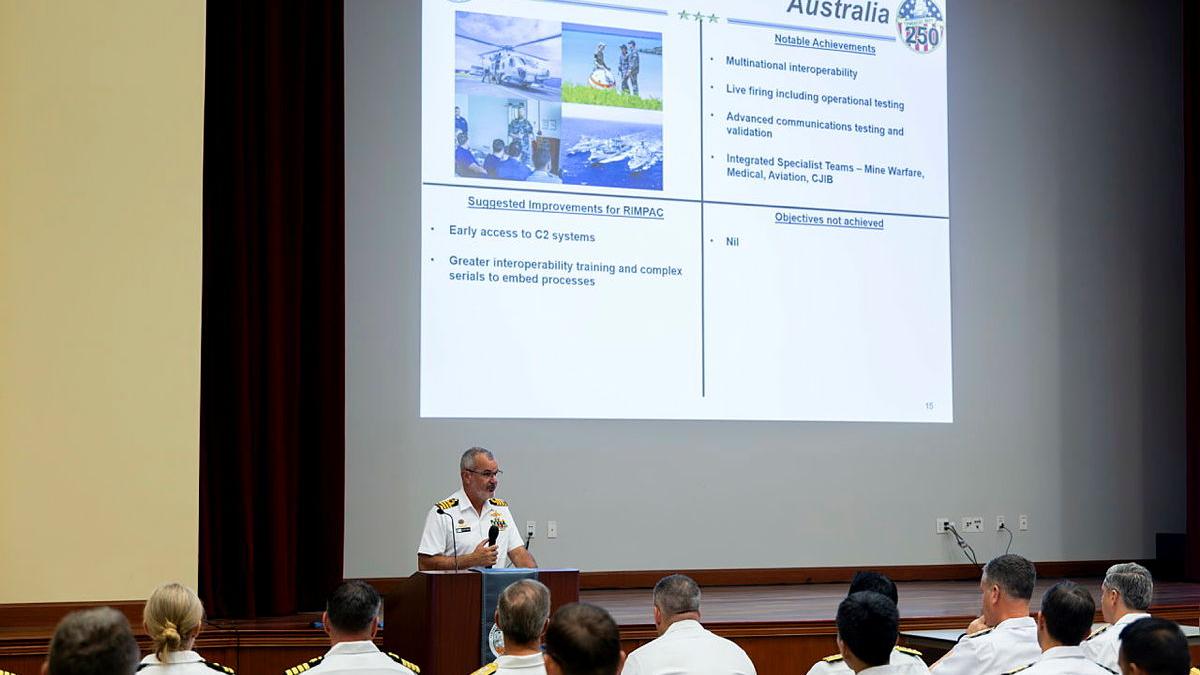
Commander of the Australian element at RIMPAC, CAPT Scott Craig, said Australia had worked alongside a diverse coalition of nations, strengthening relationships and building trust for shared challenges.
“As an integrated force, Australia successfully demonstrated multinational interoperability across planning and in command and control operations and communications,” CAPT Craig said.
“Our participation challenged our people and systems in a realistic environment. These activities provided invaluable lessons, increased our competence and collective ability to plan, coordinate and execute demanding maritime operations.”

RIMPAC featured several milestones across leadership, innovation, and combined and joint operations.
An innovation for Australia and the US at this year’s exercise included the US Navy and RAAF executing dual Long-Range Anti-Ship Missile (LRASM) launches from maritime patrol and reconnaissance aircraft.
For the RAAF P-8A presence, this year’s exercise emphasised anti-submarine warfare, as well as the first-time employment of the Lockheed Martin AGM-158C LRASM.
CO Sydney CMDR Hayden Jenkins said conducting high-end warfighting and live-fire exercises was a highlight for Sydney’s crew.
“Sydney valued the opportunity to operate in a maritime task group and conduct a range of high-end warfighting exercises with our regional partners and allies,” CMDR Jenkins said.
“Sydney’s enhanced lethality was demonstrated through the firing of a Naval Strike Missile and the dual MH-60 Romeo AGM-114N Hellfire engagement.
“The Hellfire engagement was conducted by Sydney’s MH-60 Romeo Flight 607 and an Australian MH-60 Romeo Flight 605 embarked in the US Navy destroyer USS Wayne E. Meyer conducting an interchangeability program.
“Sydney leaves Hawaii having enhanced our interoperability, demonstrated our preparedness, and strengthened professional relationships with the nations represented at RIMPAC.”
'Our participation challenged our people and systems in a realistic environment. These activities provided invaluable lessons, increased our competence and collective ability to plan, coordinate and execute demanding maritime operations.'
RIMPAC puts those principles into practice by providing a venue where participating forces train together, improve interoperability and strengthen the relationships that enable combined and joint operations.
“The network of allies and partners in the region is an asymmetric advantage,” VADM Jablon said.
“The work participating nations do at RIMPAC builds the combined and joint ability to deter conflict and supports all nations in exercising their sovereign rights and freedoms in the maritime domain.”
RIMPAC was conducted in three phases. During the shore phase, participants established multinational command relationships, planned operations and strengthened partnerships through professional exchanges, cultural events and sporting competitions.
During the at-sea phase, participating forces executed complex combined and joint training, including anti-submarine warfare, maritime strike, integrated air and missile defence, amphibious operations and logistics.
The exercise concluded with a free-play scenario in an unscripted operational environment, testing combined and joint maritime capabilities.

Throughout the exercise, participating forces executed more than 500 maritime training events, flew more than 2400 sorties and responded to more than 5000 scenario-based operational problem sets.
Vice Commander RIMPAC Combined Task Force RADM Takuo Kobayashi, Japan Maritime Self-Defense Force, said interoperability was something we must continue to develop.
“RIMPAC brings together allies and partners committed to strengthening security and stability across the region,” RADM Kobayashi said.
“The daily conversations, shared experiences and personal relationships developed throughout the exercise strengthen our ability to respond together, whether supporting maritime security or assisting communities following a disaster.”
Related stories


