Honouring a father out of sight, but not out of mind
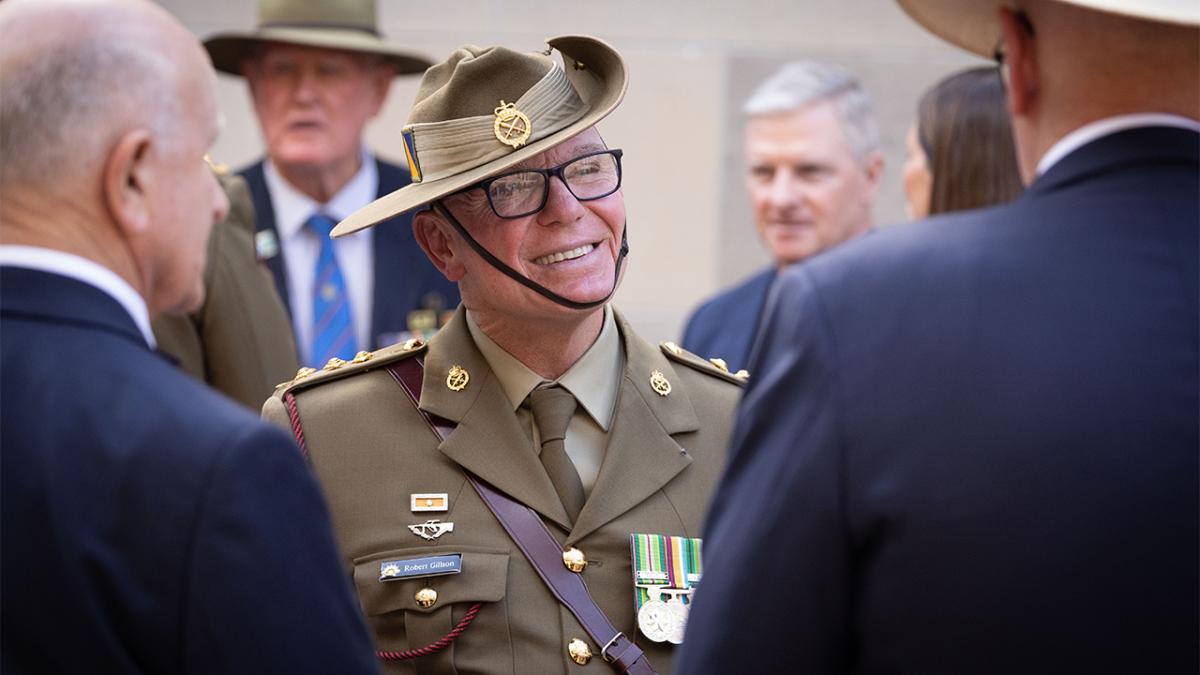
PTE Peter Gillson was 20 when he was killed in Vietnam. His son, CAPT Rob Gillson, never met him, and most of what he knows about his father's adult life he learnt from the mates he served with.
A section scout, who carried an M60 machine gun that his mates said "no one could take from him", PTE Gillson was killed fighting the Viet Cong and remained missing in Vietnam for more than 41 years.
On November 8, 1965, about 400 troops from 1RAR and the US 173rd Airborne Bde launched Operation Hump – a search-and-destroy operation in South Vietnam's Gang Toi Hills.
The US-led operation walked into a dug-in bunker system occupied by about 1200 Viet Cong soldiers.
As the battle developed, Alpha Coy, 1RAR, moved around the left flank to provide support.
What PTE Gillson and his platoon found was another section of the bunker system, where a Viet Cong battalion lay in wait.
Attacked from higher ground, PTE Gillson and LCPL Richard ‘Tiny’ Parker received heavy machine-gun fire.
CAPT Gillson, of Victorian Army Cadet HQ, said his father's platoon sergeant found two exit wounds in his back and no pulse.
“The machine-gun fire was so intense that they were unable to recover their bodies despite repeated attempts, leaving them both listed as missing in action,” CAPT Gillson said.
CAPT Gillson was four months old when his father was killed.
“Mum had only married him in January. She gave birth to me in July, and by November he was dead,” CAPT Gillson said.

Although they never met, CAPT Gillson said his father saw a photograph of him before he died and left him a letter.
“It was the kind of letter you write in case you don't come back,” he said.
“Among other things, he told me to take care of Mum.”
In 2007, an effort to locate and recover the two soldiers from the battlefield began, led by veterans and the Army History Unit, with support from private and government funding.
Although CAPT Gillson gave his full support, he said not in a million years did he expect it to succeed.
“I just had it in my mind that Dad's resting place was over there and that for whatever reason that was where he would stay,” he said.
The team located the former Viet Cong platoon commander who buried the two Australians in a forward fighting pit.
CAPT Gillson spoke with the veteran, whose recollections narrowed the search area to about 200 by 50 metres.

“He knew why I was there, and I knew what his role had been. There was mutual respect, and he felt comfortable enough to tell me how the battle unfolded,” CAPT Gillson said.
The team had 14 days to find the remains using ground-penetrating radar, and it was not until the final day that they achieved a breakthrough.
They scanned around a boulder and detected what they believed was a boot.
Over time, the boulder had rolled into the depression left by the fighting pit, almost completely covering the resting place.
When they dug, they uncovered an Australian Army boot. As the excavation continued, they found PTE Gillson's remains and dog tags, followed by those of LCPL Parker.
Following forensic testing to confirm their identities, PTE Gillson's remains were flown home to Australia aboard a RAAF C-130 Hercules, with his son on board.
Nineteen years later, organised by the Royal Australian Regiment Association, a Last Post Ceremony at the Australian War Memorial honoured PTE Gillson on November 18, with CAPT Gillson delivering the address.
Initially attending in a family capacity, his involvement later changed when the Royal Australian Regiment Association became aware he was serving in Army, at which point he took on the role of an ADF reader.
“For our family, remembering Dad and his sacrifice is incredibly important. By telling people what he did, the sacrifice he made and what it means to us, we keep his story alive,” CAPT Gillson said.
“This is something that will stay with our family for the rest of our lives.”

Related stories


