Exchange gives sappers bang for their buck
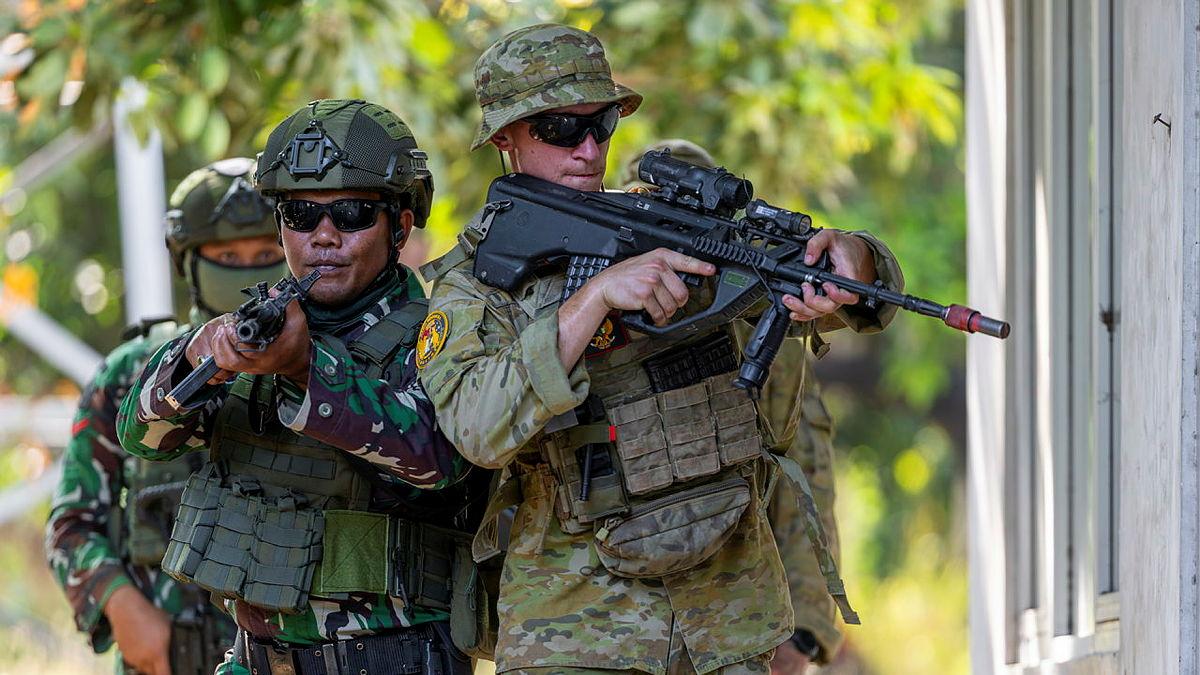
There’s something reassuringly universal about a combat engineer.
Give a sapper a suspicious device, a difficult problem or an obstacle that needs clearing, and chances are they’ll all approach it with a mix of caution, curiosity and determination.
It’s something Australian Army LT Joshua Turner, of 2CER, has discovered while working alongside explosive ordnance disposal technicians from the Indonesian Armed Forces during Exercise Keris Woomera in East Java.
“At a baseline level, we have similar capabilities, and we have similar workplace cultures,” LT Turner said.
And as he points out, there’s another shared interest.
“Everyone likes to watch things go bang,” he said.
Behind that familiar sapper humour is a serious job, and an opportunity for soldiers from both countries to learn a thing or two from each other.
During a combat engineer training exchange, LT Turner and his team put their Indonesian counterparts through simulated threats, including improvised explosive devices and suspicious caches.
The scenarios challenged soldiers to assess potential dangers, apply the appropriate procedures and, importantly, recognise when a threat should be left alone.
It’s the sort of decision-making familiar to sappers on either side of the Timor Sea.

But LT Turner said the Indonesians brought something to the exercise that the Australians couldn’t necessarily replicate.
“They've got much more hands-on experience with dealing with live UXO [unexploded ordnance],” he said.
While the Australians have shared their approach to control measures and urban search techniques, their Indonesian counterparts have demonstrated specialist equipment and methods developed through their own experience.
For Indonesian Army First Lieutenant Celio Novian Primananda, of 5th Combat Engineer Battalion in Malang, the exchange has been particularly special.
“This is the first time I have ever met soldiers from another country,” he said through translation.
“I’ve really enjoyed working with the Australian Defence Force, it has given me valuable experience.”
His soldiers have been learning Australian techniques for clearing roads of explosive hazards and conducting building clearance operations.
But First Lieutenant Primananda was quick to point out the exchange wasn’t one-sided.
“We have shown the ADF our explosive ordnance disposal vehicle and how we handle booby traps,” he said.
The value of the training for his team goes beyond the immediate exercise. He said the Australian combat engineer’s guidance would help his soldiers build their skills and confidence in dealing with explosive threats in the future.

LT Turner, who is in his first year as a troop commander, said the experience had also been a first for many of his junior sappers.
And while some of their Indonesian counterparts had served for 15 or 20 years, working with Australian soldiers was new territory for them too.
“Honestly, it’s been good to just work with them,” First Lieutenant Primananda said.
“Really, it’s about making that relationship.”
It’s a relationship based off being a good sapper, and getting the job done, which matters far more than which flag is sewn onto a uniform.
For First Lieutenant Primananda, the experience has already left a lasting impression.
Asked whether he would work alongside Australian soldiers again, there was no hesitation.
“Yes, of course,” he said.
“I have really enjoyed working with the ADF. Their team has been extremely helpful in giving us valuable experience for the future.”
Despite different equipment, different procedures and occasionally needing someone to translate, when it comes to solving problems, looking after their mates and sharing a laugh along the way, it seems sappers have plenty in common.

See more images from Exercise Keris Woomera.
Related stories


