Stress test pushes health teams to the limit
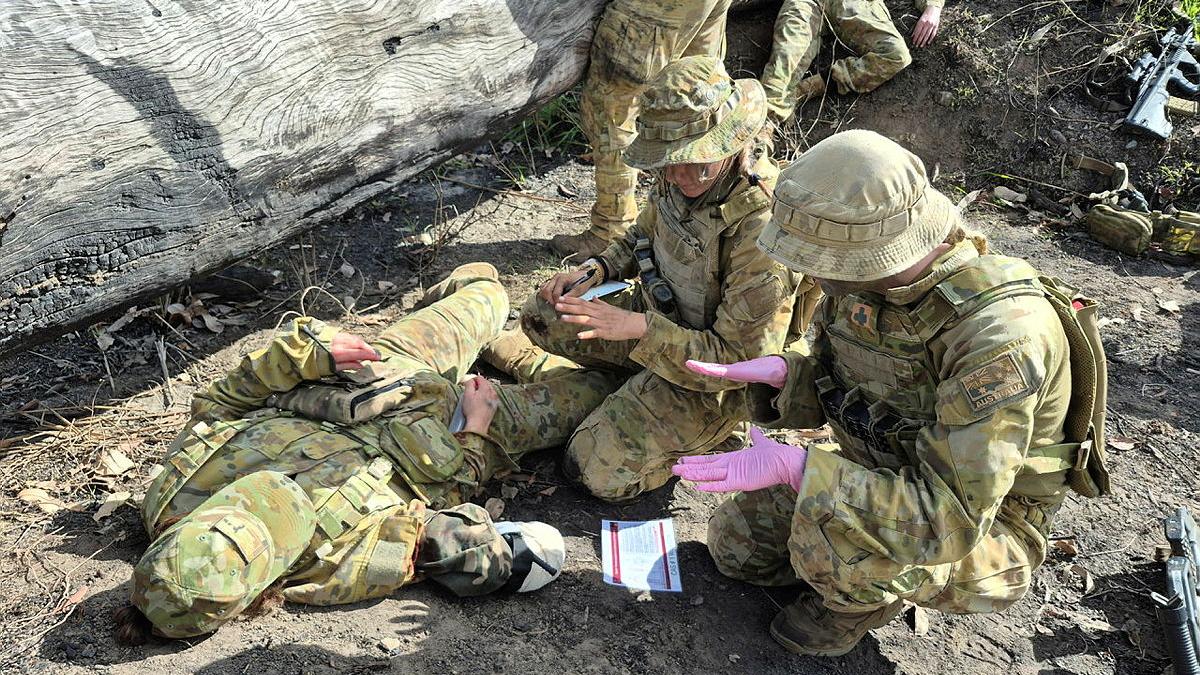
Austere conditions, intense urban combat, a fast-moving battlespace and multiple mass-casualty scenarios.
This is the backdrop against which the Australian Army’s 2 Health Bde was tested as part of Exercise Pozières Run, the 1st (Australian) Division’s annual Warfighter event, to prepare for war.
The culmination was a “stress and test” of 2 Health Bde’s people and capabilities, as a trickle of casualties became a flood, which threatened to overwhelm the deployed health facility.
Lt-Col Greg Brown, the brigade’s lead training officer, said the true value of the exercise was the realism of the injuries, some of them simulating the worst damage modern weapons can do to the human body.
“The whole idea of having casualties who are moulaged, or have medical makeup applied, is that the first time a health technician, a combat first-aider, or simply an Australian soldier sees an injury that is commensurate with modern day warfare, it’s not during conflict, but during training,” Lt-Col Brown said.
Named after a ferocious WWI battle in which Australian troops captured the French village of Pozières in a daring night assault and held it against repeated German counter-attacks – suffering grievous losses in the process – the exercise involved more than 6000 personnel operating across central and northern Queensland.
Shoalwater Bay Training Area became the notional ‘Shoalwater Island’, a small but strategically vital piece of land off Australia’s coast – the kind Australia might need to dominate in a future conflict.
The units receiving 2 Health Bde’s expert medical support faced a hard fight for possession of the island against a determined and committed ‘enemy’ – played by Australian forces – resulting in a series of violent clashes across the area, and a steady stream of casualties.
As the exercise progressed, Lt-Col Brown and his team introduced a series of increasingly challenging and complex health serials ranging from deadly artillery strikes, to air crashes, to enemy ambushes. They progressively ratcheted up the pressure on the various component parts making up what’s known as the land-based trauma system – the casualty treatment chain which processes and looks after wounded troops, from point of injury to care.

'This has been a brilliant opportunity to see the new generation of Australian health technicians rising to the needs of future actions.'
Speaking outside the Role 2 Basic (R2B) facility – which includes an emergency department and an operating theatre to stabilise serious casualties before they are sent for more definitive care – Maj Thomas Patterson, a trauma surgeon and member of the coaching team, described the scene.
“We've got a number of people triaging and providing initial treatment in the front area,” Maj Patterson said.
“Then we’ve got a small reception which leads through to the resuscitation area where people are getting their lifesaving treatment in the very early moments after arriving.”
One of the most difficult decisions clinicians make under these challenging circumstances is which casualties can and should be treated first – ahead of those with injuries deemed so severe they’re likely not survivable.
Scenarios like Exercise Pozières Run enable the treatment teams to learn the tough lessons under conditions which are pressurised and carefully controlled.
Once the critical decisions have been made, the surgical teams get to work.
“We’ve got two surgeons and theatre staff around them performing surgery. And we've got some casualties being held in a high-dependency area and ward, so we're providing all levels of treatment,” Maj Patterson said.
The R2B sits in the middle of the field treatment construct, with the smaller Role 2 Forward (R2F), located nearer the front, offering limited lifesaving surgical interventions. The much larger Role 2 Enhanced (R2E) – essentially a small hospital based in a relatively secure location further to the rear – offers an array of specialist capabilities, despite its mobility and the speed at which it can be set up.

“Pretty much every specialty that we have in Army Health is represented here at various times. We've got a backbone of health technicians and nurses who really hold the place together like a glue,” Maj Patterson said.
“Then there are specialist services like pathology. We've got some scientific officers in there working to give us the blood tests that we need to make decisions. There are some trauma surgeons in there and anaesthetists and emergency department specialists. And we've got other sub-specialty functions like imaging and radiography.”
Perhaps most impressive of all, the R2E boasts a fully deployable CT scanner, making diagnoses faster and more accurate, and improving results for casualties of almost every description.
At the other end of the chain are the combat first-aiders. They are trained in advanced trauma skills by 2 Health Bde instructors from the brigade’s four health battalions, and provide the first line of care to a wounded soldier.
Their sole aim is to stabilise casualties and prevent them from deteriorating.
Lt-Col Brown said seeing these relatively junior soldiers hone their skills in a dynamic, fast-paced tactical environment was the best part of his job.
“This has been a brilliant opportunity to see the new generation of Australian health technicians rising to the needs of future actions,” Lt-Col Brown said.
“Seeing them do the job under realistic circumstances, being pushed to the limit personally and rising to the challenge is extremely rewarding.
“The whole idea of coaching is to encourage people to draw on their own experiences and those to their left and right to come up with the correct answers, and seeing those people bond together to find solutions to difficult problems in arduous situations to save life is just amazing.”

Related stories


