Tully prepares troops for jungle warfighting
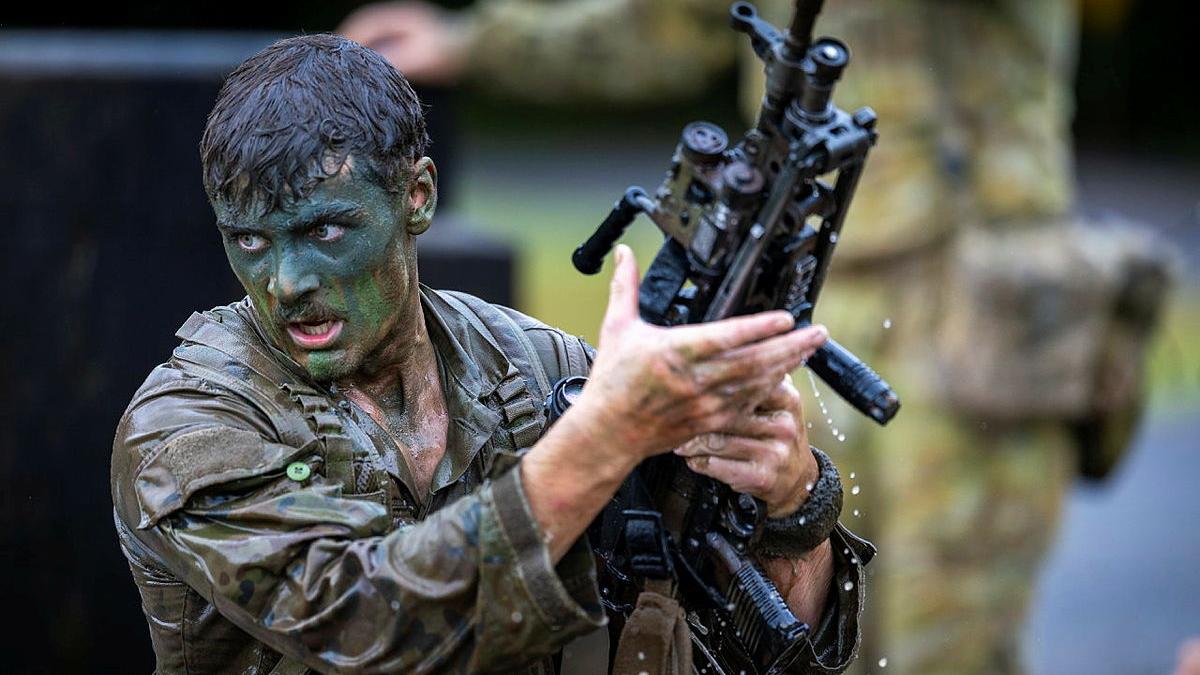
Deep in Tully’s jungle in Far North Queensland, a young soldier lies on his stomach in a muddy gun pit.
Rain drips through the dense canopy overhead, pooling on the brim of his bush hat, trickling down his neck.
Overnight, a tropical downpour turned his improvised sleeping position into a large muddy puddle, leaving him cold, exhausted and completely soaked through.
Hordes of mosquitoes swarm relentlessly, probing every patch of exposed skin, attacking eyelids, ears, neck and nostrils.
Training in these unforgiving conditions is designed to teach soldiers a lesson Australia's military learned the hard way during World War II as well as later conflicts in Malaya, Borneo and South Vietnam.

When Australian troops first encountered Imperial Japanese Armed Forces in the jungles of Malaya in 1941, they were unprepared to operate in one of the world’s most unforgiving environments.
Disease and climate took a devastating toll, with malaria, scrub typhus, fungal infections, dysentery, exhaustion and exposure claiming more Australian lives than enemy bullets.
Recognising the need for specialised preparation, Australia established the Jungle Training Centre at Canungra in 1942.
There, troops from the 6th, 7th and 9th Divisions were immersed in conditions designed to approximate jungle combat; learning how to patrol, survive and fight in close terrain.
As a result, Australian units became more proficient in jungle warfare, contributing to successful campaigns in New Guinea and Borneo during the latter years of the war.
Jungle training was disbanded in 1946 amid predictions that future conflicts would be fought elsewhere.
But the rise of counterinsurgency operations in South-East Asia soon proved otherwise, prompting the centre’s re-establishment in 1954.
'The jungle is an unforgiving teacher – it punishes complacency. '
In 1980, jungle training was relocated to Tully, where the close terrain offered a better approximation of the tropical environments soldiers might encounter across the Pacific and South-East Asia.
OC Jungle Training Wing Maj Chris Wetherell said this capability was becoming increasingly relevant as Defence focused on Australia’s northern approaches.
“When we talk about where we're expected to operate in the event of large-scale combat operations, and even future security and stability operations, that's likely within the Pacific and South-East Asian regions,” Maj Wetherell said.
“These are areas dominated by both urban terrain and jungle environments.
“We don't want a soldier's first exposure to this environment to be during a battle.”

For many soldiers – most of whom are recruited from cities and regional towns – that first encounter can be a shock.
Lt Matthew Poynting, a platoon commander at 8/9RAR, attended the ambush course in February before returning to Tully in June for Jungle Warfighter Exercise (J-WFX).
For him, the rain presented the greatest challenge.
“It deteriorates everything – your equipment, your feet, your whole body,” Lt Poynting said.
“When your sleeping gear gets wet, you lose sleep and you get colder, that starts to play on your mind.”
Pte Rashad Miles found simply moving through the terrain to be one of the biggest obstacles.
“The vegetation slows everything down,” Pte Miles said.
“You've got wait-a-while vines, Gympie Bush – things that will hurt you if you try to rush through them.”
Navigation also becomes significantly more difficult beneath the dense canopy.
“You have to be much more precise because there are fewer reference points to work with on a map,” Pte Miles said.
In more open terrain, a six-kilometre patrol might take only a few hours. In the jungle, the same distance can take days.
'We don't want a soldier's first exposure to this environment to be during a battle.'
Other soldiers described struggling to maintain radio communications through thick vegetation that absorbs and blocks signals.
Some also recounted waking to find rats the size of Chihuahuas gnawing through their packs in search of ration scraps.
According to Maj Wetherell, this was the hardest training on offer in the Army outside of Special Operations Command.
“The jungle is an unforgiving teacher – it punishes complacency,” he said.
“If you take shortcuts or you're not up to muster it will be exposed very quickly.
“Sleep with your boots on and you'll end up with foot immersion, which can lead to trench foot.
“Fail to prepare your sleeping area properly and you'll wake up with wet sleeping gear.
“Ignore a blister and it can develop into a tropical ulcer.”

Since commencing his posting in early 2025, Maj Wetherell has focused on strengthening basic fieldcraft skills through increased instruction, returning soldiers to fundamentals to ensure they master essentials such as conducting routines to keep their kit as dry as possible and correctly setting up their sleeping positions.
At the end of the day, these skills cannot be fully taught in a classroom environment.
“You can only do this through living in it and getting dirt under your fingernails,” Maj Wetherell said.
“There’s no campus course that can replicate what the jungle provides.
“And it’s not about doing it once and then you are good to go forever; you need to be tested time and time again.”
While Maj Wetherell acknowledges the jungle is unforgiving, he believes that with sufficient training and application of the learned skills, as well as self-discipline, determination and good leadership, Australian soldiers can learn to effectively and comfortably operate within it.
He also pointed to a range of operational advantages the environment could provide.
“The jungle offers protection from a lot of modern systems such as drones,” he said.
“The canopy can interfere with aerial observation and reduce the effectiveness of thermal scanning.
“It can also reduce collateral damage compared to urban environments, where the risk to civilians is far higher.”

Lt Poynting concurred that the density of the terrain, compared to more open urban environments such as those seen in Ukraine, could make concealment significantly easier.
“You can get much closer to the enemy and remain hidden,” Lt Poynting said.
To prepare for a broader range of potential future conflicts, J-WFX has, in recent years, shifted its emphasis from counterinsurgency operations towards large-scale combat operations.
“Counterinsurgency tends to be prolonged,” Maj Wetherell said.
“You often have more time to conduct reconnaissance and understand the environment.
“Large-scale combat operations don’t give you that luxury.
“You have to make decisions quickly, often in conditions that are not ideal.
“In that context, the jungle is extremely demanding.
“Defensive operations are difficult, but if you identify weaknesses, you can strike and withdraw rapidly.
“Ambush is still a big focus, but instead of just targeting a six-person group we are looking at targeting the vanguard of a large force advancing to secure a road; fighting for the road, off the road.”
Despite its challenges, Maj Wetherell is adamant about the value of jungle warfighting.
“Both environments are complex. But if I had my way, I’d choose the jungle any day,” he said.

Related stories


