Dominating the drone racing competition
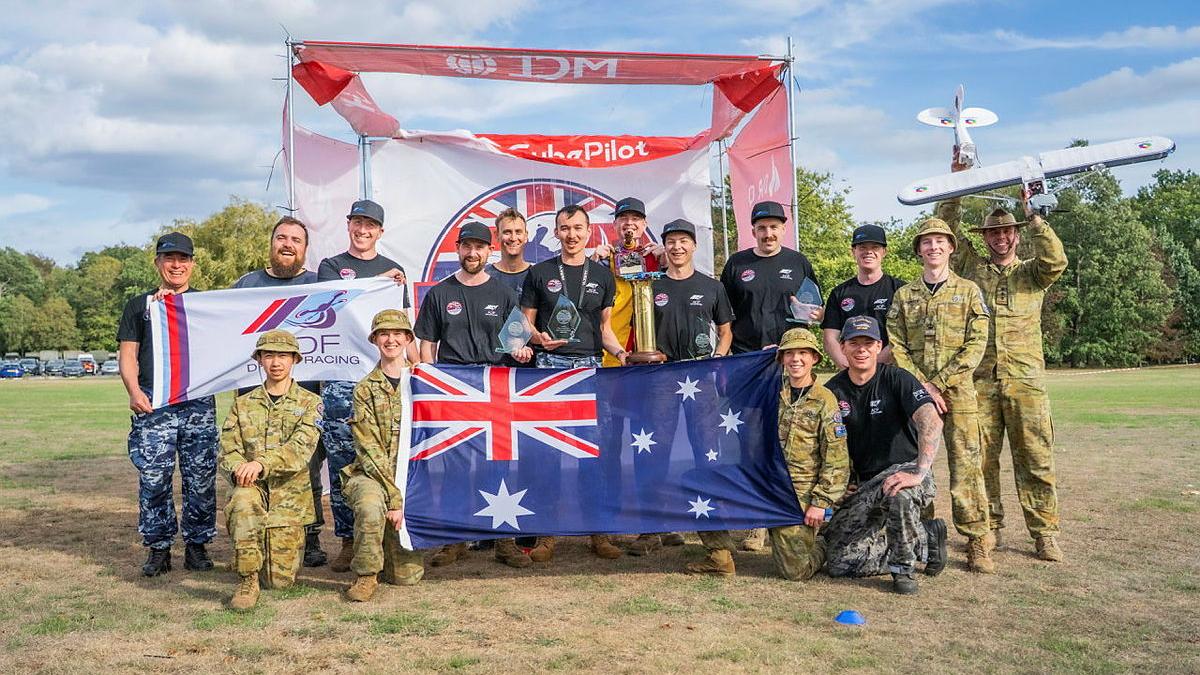
The ADF Drone Racing Team won its eighth Military International Drone Racing Tournament (MIDRT) in the UK in September.
The team competed against teams from France, Germany, New Zealand, Slovenia, Sweden, Ukraine, the UK and the US.
A Ukrainian team competed for the first time, highlighting the rapidly evolving role of uncrewed aerial systems (UAS) on the modern battlefield.
Their presence reinforced one of the key purposes of MIDRT, which is to create an environment where drone pilots, military personnel and industry can exchange knowledge about the development and practical application of UAS technology.
The latest MIDRT event moved beyond conventional racing, with teams competing in a tactical event incorporating an intercept, bomb drop and assault course.
Each team of four pilots competed against the clock, combining speed and precision with tactical judgement and accurate aircraft control.

Pilots were required to intercept fixed-wing aircraft, navigate a complex assault course and deliver simulated munitions against multiple targets.
ADF drone pilot and Geelong-based Army reservist PTE Hamish Glover again dominated the competition, taking out first place as the fastest military drone pilot.
PTE Glover said the tournament provided an opportunity for pilots to not only represent the ADF but to learn from the experiences of other drone pilots.
“Drone racing develops skills that are relevant to the warfighter,” he said.
“Skills that can transfer into operational environments where an uncrewed system may be required to perform a mission in a complex, contested or rapidly changing environment.
“We are extremely proud to have won the tournament again.
“Our mission is simple: race hard, learn fast and continue to build the skills needed for the warfighter.”
Related stories


