Paving the taxiway to success
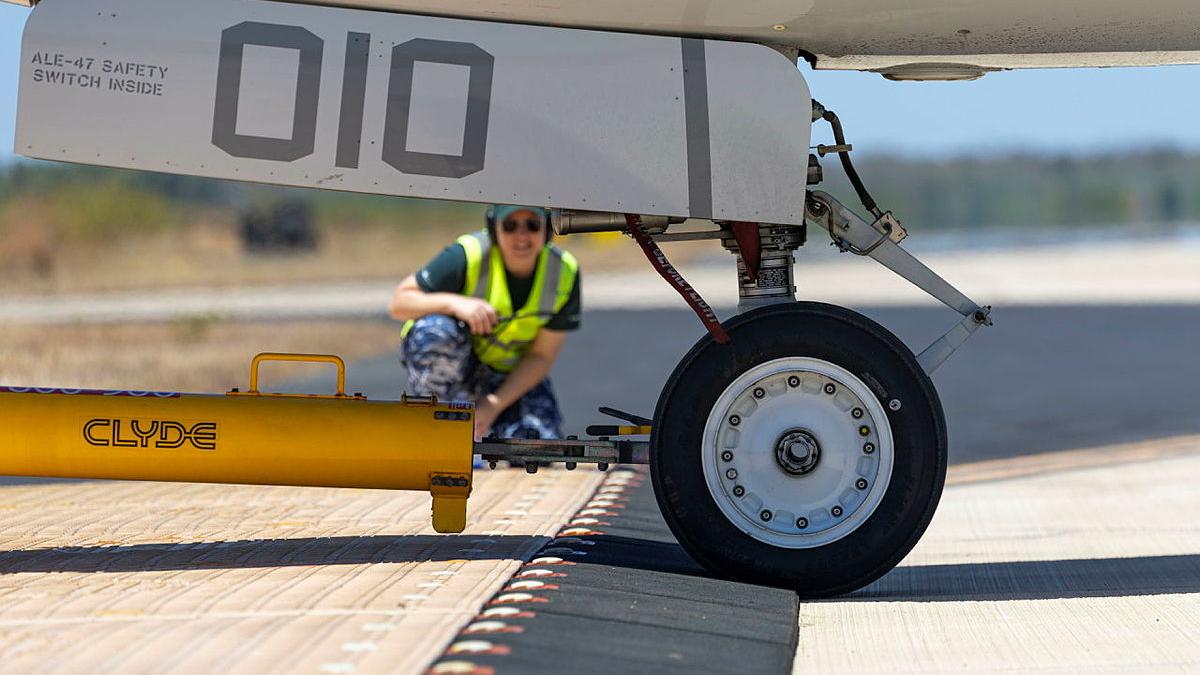
A taxiway – that did not exist 12 hours prior – held the concentrated weight of a P-8A Poseidon, marking a milestone for military engineers participating in Exercise Bronze Croc 26 (BC26).
Conducted at RAAF Base Tindal, the world-first assessment validated Dura-Base matting, a portable taxiway surface, as an expedient aircraft movement surface capability able to support air operations in austere and contested environments.
While BC26 has already delivered six personnel protective shelters and a single dome shelter across the northern base, it was the P-8A trial that engineers described as the exercise’s standout achievement. Not just for what it proved, but for how quickly it was delivered.
SQNLDR Benjamin Whyte, the exercise detachment commander for BC26, said the successful assessment was the culmination of extensive planning, engineering analysis and teamwork.
"No one has ever put a heavy aircraft under power across Dura-Base matting before. The testing data showed it could be done, but to physically see a P-8A successfully traverse the surface in such a short timeframe is highly rewarding,” SQNLDR Whyte said.
“The apron itself was a late pivot. The team redirected to the site in roughly 12 hours, with no ground preparation, after an initial planned location was assessed as less suitable.”
The trial was a combined effort, with military engineers and personnel from RAAF, the US Marine Corps, the US Navy and the US Air Force working in integrated teams to plan, construct and validate the expedient surface.
Deputy Director Airbase Resilience and Exercise Director for BC26 WGCDR Rhys Belnap said he was proud of what the multinational team had achieved throughout the exercise.

'The success of the apron trial shows what can be achieved when partner nations work together towards a common objective.'
“The apron trial reflects the dedication and professionalism of every engineer involved,” WGCDR Belnap said.
“Australian and US personnel worked together, bringing a range of skills and experiences to deliver a capability we’re all proud of.
"One of the greatest strengths of Bronze Croc 26 has been the level of interoperability across the force.
“We formed integrated teams with personnel from all four services, and people were able to work interchangeably across roles, adapting quickly and supporting one another to get the job done."
WGCDR Belnap said the exercise provided an opportunity to build confidence and strengthen partnerships between participating nations, while demonstrating the agility required to deliver operational effects in northern Australia.
“Bronze Croc 26 gives our multinational engineering teams the opportunity to build trust, share knowledge and develop the relationships that underpin future operations,” he said.
“The success of the apron trial shows what can be achieved when partner nations work together towards a common objective.”
Rather than avoiding risk, engineers focused on understanding and managing it while still allowing the team to push the boundaries of what military engineers can achieve.
“We know the challenges we're facing, and we know the importance of resilient northern bases. Success comes from carefully managing risk while continuing to innovate and deliver capability,” WGCDR Belnap said.
The P-8A trial builds on RAAF’s earlier milestone of operating a fifth-generation fighter over Dura-Base matting, giving the service two world-first achievements.

Related stories


